Dual Diagnosis Treatment in Pakistan: When Addiction and Mental Health Coexist
Author: Dr. Obaid Ullah Khan, Consultant Psychiatrist, Federal City Rehab Clinic. Specialist in psychiatric assessment and treatment of depression, anxiety disorders, bipolar disorder, schizophrenia, PTSD, OCD, and dual diagnosis presentations.
A pattern keeps repeating in the families who come to Federal City Rehab Clinic. They have already tried treatment. Often more than once. A son who completed a 30-day programme and was using again within weeks. A husband whose drinking stopped during rehab and resumed within months of discharge. A daughter who has been through three different facilities and whose situation is, somehow, worse than when she started.
The families arrive exhausted and increasingly hopeless, convinced that their loved one is beyond help or that they themselves have failed in some way they cannot identify. They are not beyond help. They have not failed. What has almost always happened is that the previous treatment addressed only half of what was actually wrong.
Most patients with serious addiction in Pakistan are also dealing with an underlying mental health condition. Depression. Anxiety. Post-traumatic stress disorder. Bipolar disorder. Often these conditions have never been diagnosed. The patient has been using substances to manage psychiatric symptoms they did not know they had, and treatment that focuses only on the addiction leaves the underlying driver completely intact. The relapse that follows is not failure. It is the predictable result of incomplete treatment.
This is what dual diagnosis treatment is designed to address. This guide explains why dual diagnosis matters so much in the Pakistani context, why standard addiction treatment so often fails the patients who need it most, and how genuinely integrated treatment produces different outcomes.
If you would like to speak with a qualified psychiatrist about your situation, FCRC’s admissions team is available 24 hours a day. The conversation is completely confidential and commits you to nothing.
What Dual Diagnosis Actually Means
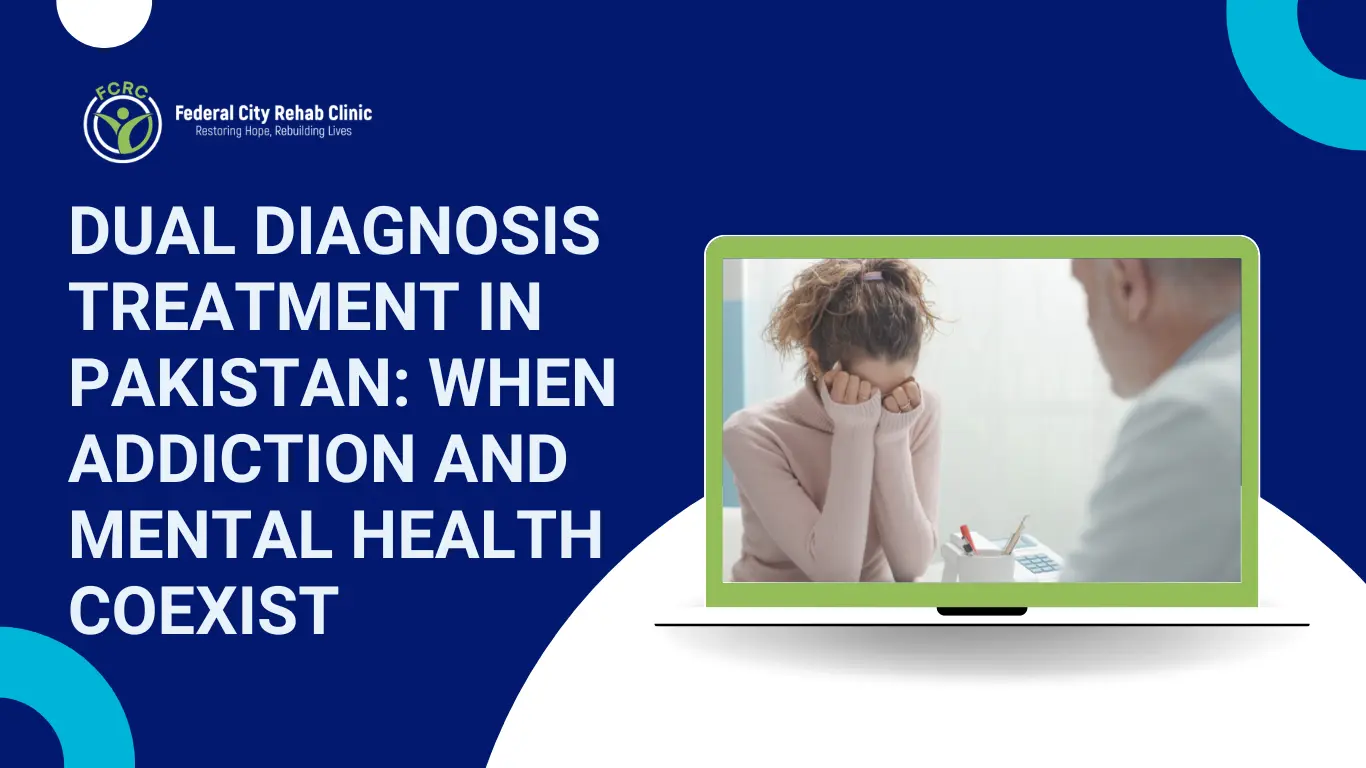
Dual diagnosis, also called co-occurring disorders, refers to the simultaneous presence of a substance use disorder and one or more mental health conditions in the same person. The two conditions exist together, affect each other in ways that make both worse, and must be treated together for either to genuinely resolve.
According to the Substance Abuse and Mental Health Services Administration, approximately half of all people with a serious mental illness will also develop a substance use disorder at some point in their lives, and vice versa. In specialised addiction treatment settings, where the most severe presentations concentrate, the proportion is higher still. Dual diagnosis is not a rare or unusual category of patient. It is, statistically, the majority of patients presenting with significant addiction.
The clinical implication is straightforward. If most addiction patients also have a mental health condition, then most addiction treatment programmes that do not address mental health are providing inadequate care to the majority of their patients.
The Pakistan-Specific Reality
The dual diagnosis picture in Pakistan is more severe than in countries with better mental health infrastructure. Two factors compound to produce this.
The first is Pakistan’s enormous mental health treatment gap. According to the World Health Organization, the proportion of people with mental health conditions who receive no treatment at all is significantly higher in low and middle income countries. In Pakistan specifically, estimates consistently indicate that more than 75 percent of people with diagnosable mental health conditions never receive professional care. This is a country where untreated depression, untreated anxiety, untreated PTSD, and untreated bipolar disorder are not exceptions but the norm.
The second is the cultural stigma around mental illness that drives people towards self-medication rather than psychiatric care. In a context where seeing a psychiatrist carries social risk, where mental illness is often interpreted in moral or spiritual rather than medical terms, and where the available services are limited and inaccessible to most, many Pakistanis manage psychiatric symptoms in the only ways they can find. Often that means substances.
The young man whose untreated social anxiety made daily interactions unbearable discovers that alcohol or benzodiazepines temporarily fix the problem. The mother whose untreated postpartum depression made motherhood feel impossible discovers that prescription sedatives bring brief relief. The father whose untreated PTSD from a past trauma made nights unbearable discovers that heroin lets him sleep. These are not isolated stories. They are common, structurally produced patterns that follow directly from the gap between the country’s mental health needs and its mental health services.
When these patients eventually arrive at an addiction treatment facility, the substance use is what gets seen. The underlying mental health condition that has been driving everything often goes undiagnosed, even within the rehabilitation setting. The patient is treated for the addiction and discharged, with the original problem completely unaddressed.
Why Standard Addiction Treatment Fails Dual Diagnosis Patients
Most rehabilitation facilities in Pakistan are not equipped to identify or treat co-occurring mental health conditions. The reasons are practical rather than ideological.
Many facilities do not employ consultant psychiatrists at all. Where psychiatric input exists, it is often limited to initial assessment or crisis management rather than ongoing involvement in treatment. Clinical psychology services, where available, are typically focused on addiction-specific therapy rather than the broader range of mental health conditions that present alongside it. The infrastructure required to deliver genuine integrated dual diagnosis treatment is meaningfully more complex than what most facilities provide.
The result is that patients with dual diagnosis presentations are essentially treated as if they had only the addiction. The therapeutic content focuses on substance use. Medication management, if it happens at all, focuses on detoxification and basic stabilisation. The psychiatric condition that has been driving everything is not properly identified, not adequately diagnosed, and not treated within the programme.
This produces a specific outcome that families recognise but often cannot explain. The patient completes the programme. They are substance-free at discharge. They return home with renewed determination. And within weeks or months, the underlying psychiatric symptoms that have been temporarily masked by the structure of residential treatment return in full force. The patient has no clinical tools to manage these symptoms because no one has diagnosed or treated them. The substance that previously provided relief is the only thing the patient knows that helps. Relapse follows.
This is not a failure of patient motivation or family support. It is a failure of clinical scope. Treatment that addresses only the addiction cannot produce sustained recovery when the addiction is driven by an untreated mental illness.
The Mental Health Conditions Most Commonly Co-Occurring with Addiction
In our clinical experience at FCRC, several patterns of co-occurrence appear with particular frequency. Recognising these patterns helps families understand what may actually be happening in their loved one’s situation.
Depression with Alcohol Use Disorder
Depression and alcohol dependency are deeply intertwined. Each makes the other worse. Patients with untreated depression often discover that alcohol provides temporary relief from emotional pain, but alcohol use ultimately deepens depression neurologically and socially. Patients with developing alcohol dependency develop depression both from the substance’s effects and from the consequences of dependency. Treating either condition alone, without the other, almost always fails.
Anxiety Disorders with Benzodiazepine Dependency
This is perhaps the most preventable dual diagnosis pattern. Patients with untreated anxiety disorders are prescribed benzodiazepines like Xanax, often by general practitioners without adequate psychiatric oversight. The medication produces rapid relief, then dependency, then a worsened version of the original anxiety once dependency develops. The underlying anxiety was never properly assessed or treated through appropriate evidence-based approaches. The dependency is layered on top. Both need to be addressed simultaneously.
PTSD with Heroin or Opioid Addiction
Trauma-related conditions, particularly PTSD from childhood abuse, domestic violence, or other adverse experiences, frequently drive opioid dependency. Heroin and prescription opioids provide a particular kind of psychological numbing that is uniquely effective at suppressing trauma-related symptoms. The patient often describes substance use as the only thing that ever made the underlying pain bearable. Without addressing the trauma directly, sustained recovery from opioid dependency is genuinely difficult.
Bipolar Disorder with Multiple Substance Use
Patients with undiagnosed bipolar disorder, particularly during manic or hypomanic episodes, frequently develop patterns of multiple substance use including stimulants like ICE, alcohol, and various other substances. The impulsivity of mania and the despair of depression both create powerful vulnerability to addiction. Treatment that does not include accurate diagnosis and management of the underlying bipolar disorder fails.
Schizophrenia and Psychotic Disorders with Cannabis or Stimulant Use
Cannabis and stimulant use significantly worsen psychotic illness, and many patients with developing or established schizophrenia use these substances either to manage symptoms or as a form of social escape. Cannabis-induced psychosis can also mimic schizophrenia, making accurate differential diagnosis a critical clinical task that requires specialist psychiatric expertise. Without psychiatric input throughout treatment, these complex presentations are not safely managed.
Personality Disorders with Various Substance Dependencies
Borderline personality disorder in particular frequently presents alongside substance use, with the substances often serving as ways to manage the intense emotional dysregulation characteristic of the condition. Treatment requires both addiction-focused work and specific therapeutic approaches like Dialectical Behaviour Therapy for the personality disorder dimension.
If your loved one’s situation matches any of these patterns, a confidential conversation with FCRC’s clinical team can help clarify what is actually happening clinically.
What Genuine Integrated Treatment Looks Like
Effective dual diagnosis treatment is not simply addiction treatment with a psychiatrist available for consultation. It is a fundamentally integrated clinical model where the addiction and the mental health condition are addressed simultaneously within the same coordinated programme, by the same multidisciplinary team, using approaches calibrated to the specific co-occurrence pattern.
According to the National Institute on Drug Abuse, the evidence consistently supports integrated treatment over sequential or parallel approaches. Patients who receive addiction treatment first and mental health treatment second, or who see different clinicians for each condition without coordination, achieve significantly worse outcomes than patients whose conditions are managed together by an integrated team.
At FCRC, dual diagnosis treatment begins with comprehensive psychiatric assessment that explicitly looks for co-occurring conditions. This is not a screening question added to an intake form. It is a thorough clinical evaluation by a consultant psychiatrist, covering the patient’s full psychiatric history, current symptoms, family history, trauma history, and the specific relationship between any identified mental health conditions and the substance use.
Treatment planning is then integrated from the start. The medical, psychiatric, and psychological dimensions of care are coordinated through a single clinical team rather than handled separately. Medication management for the mental health condition, where indicated, runs alongside addiction-focused therapy. Psychological therapy addresses both the substance use patterns and the underlying psychiatric drivers. Family therapy considers the dynamics that affect both conditions.
Medically supervised detoxification for dual diagnosis patients accounts for the additional psychiatric complexity. Many patients in withdrawal experience emergence or worsening of psychiatric symptoms that require active management during the detox period itself. This is not a complication. It is a clinical reality that integrated programmes are designed to handle.
Throughout the residential programme, psychiatric review continues as an active component rather than a one-off intervention. As the patient stabilises from the substance use, the underlying psychiatric condition becomes clearer and treatment is adjusted accordingly. Many patients only receive accurate diagnosis of their underlying mental illness once the substance use has been removed long enough for the clinical picture to be seen properly.
Aftercare planning explicitly addresses both conditions. The relapse prevention plan covers substance-specific triggers, but it also covers psychiatric symptom management, medication adherence, and the warning signs of mental illness recurrence. Both dimensions are part of sustained recovery, and both are accounted for in the plan the patient leaves with.
Why FCRC Is Equipped for Dual Diagnosis Cases
Federal City Rehab Clinic was structured around the recognition that most serious addiction cases involve co-occurring mental health conditions, and the clinical infrastructure reflects this.
Our consultant psychiatrists hold FCPS qualifications and have specific expertise in the psychiatric conditions most commonly presenting alongside addiction in Pakistan. They are actively involved in patient assessment and ongoing treatment throughout the programme, not just at initial intake. Our clinical psychologists hold M.Phil and doctoral level qualifications and deliver the evidence-based therapeutic modalities that dual diagnosis presentations require, including CBT, DBT, trauma-informed therapy, and motivational interviewing.
The integrated treatment model means that the addiction medicine, psychiatric care, and psychological therapy components are coordinated through a single clinical team rather than fragmented across separate specialists. Comprehensive mental health and psychiatric services are not an add-on to the addiction programme. They are part of the same coherent clinical pathway.
The Bani Gala location provides the therapeutic environment that dual diagnosis recovery particularly requires. Patients are removed from the daily stressors that contribute to both the substance use and the psychiatric symptoms, given the structured environment in which both can be properly assessed and treated, and provided with the calm setting that supports the extended therapeutic work that dual diagnosis cases often need.
Confidentiality is unconditional. For patients particularly concerned about the social consequences of either a psychiatric diagnosis or a substance use diagnosis, nothing is shared without explicit written consent. Initial enquiries can be made anonymously.
Patients are regularly admitted from across Pakistan, with transport coordination available for those travelling from Rawalpindi, Peshawar, Lahore, Karachi, Multan, and beyond.
If You Have Tried Treatment Before Without Success
For families who have already been through one or more rehabilitation programmes that did not produce lasting recovery, the most useful clinical question is whether the previous treatment adequately addressed any co-occurring mental health conditions. Often it did not, and that is the explanation for why treatment that seemed to be working at discharge did not hold afterwards.
This is not a criticism of the patient who relapsed, the family who supported them, or even necessarily the previous facility. It is a clinical reality that incomplete treatment produces incomplete outcomes. The next round of treatment, if it is going to produce different results, has to actually address what was missed before.
A comprehensive psychiatric assessment at FCRC can identify whether previously unrecognised conditions are driving the pattern, and develop a treatment plan that addresses the full clinical picture rather than just the visible symptoms.
Frequently Asked Questions
What is dual diagnosis treatment?
Dual diagnosis treatment is the simultaneous, integrated treatment of a substance use disorder and one or more co-occurring mental health conditions within a single coordinated clinical programme. It is necessary because most patients with serious addiction also have an underlying mental health condition that drives or sustains the substance use, and treating either condition alone typically produces incomplete recovery.
How common is dual diagnosis among addiction patients in Pakistan?
Statistically, the majority of patients presenting for serious addiction treatment also have a co-occurring mental health condition. International research suggests approximately half of patients with serious mental illness have a substance use disorder and vice versa. In Pakistan, where the mental health treatment gap is particularly large, the proportion of addiction patients with undiagnosed underlying conditions is likely even higher.
Why does standard addiction treatment fail dual diagnosis patients?
Because it addresses only one half of the clinical picture. If untreated mental illness is driving the substance use, treating the substance use without addressing the mental illness leaves the underlying driver completely intact. The patient typically appears to recover during the structured environment of residential treatment, then relapses within weeks or months of discharge when the original psychiatric symptoms return in full.
How does FCRC's dual diagnosis approach differ from standard addiction treatment?
The clinical model is genuinely integrated rather than parallel. Consultant psychiatric care, evidence-based psychological therapy, medical management, and addiction-focused work are coordinated through a single multidisciplinary clinical team. Both conditions are assessed thoroughly at admission, both are addressed throughout the programme, and the aftercare plan covers both dimensions explicitly.
Can dual diagnosis treatment work if previous treatment failed?
Yes, and often the difference is precisely the integrated approach. If previous treatment focused only on the addiction without addressing co-occurring mental health conditions, accurate diagnosis and proper treatment of those conditions can produce fundamentally different outcomes than the previous round. Many of FCRC’s most successful recoveries are with patients who had been through previous treatment without lasting success.
Is dual diagnosis treatment more expensive than standard addiction treatment?
At FCRC, dual diagnosis capability is built into every clinical pathway rather than billed as a separate service. The cost reflects the higher clinical staffing ratio and integrated multidisciplinary care that the approach requires, but it is not structured as an add-on to a basic addiction programme. Cost discussions are handled directly with our admissions team based on the specific programme recommended following assessment.
Conclusion
Dual diagnosis is not an exotic or unusual presentation. It is the clinical norm for serious addiction in Pakistan, made more severe by the country’s significant mental health treatment gap. Patients with addiction whose underlying psychiatric conditions remain unrecognised receive incomplete treatment, and the relapse that often follows is not random failure but predictable clinical consequence.
What changes outcomes is integrated treatment. Comprehensive psychiatric assessment that explicitly looks for co-occurring conditions. Coordinated clinical care that addresses both the addiction and the mental illness within the same programme. Evidence-based therapy that targets both dimensions. Medication management where indicated for the psychiatric condition, alongside addiction-focused work. Aftercare that accounts for the management of both conditions over the long term.
Federal City Rehab Clinic was designed to provide exactly this kind of integrated treatment. For families whose previous treatment attempts have not produced lasting recovery, and for families starting this process for the first time who want to ensure they are getting genuinely comprehensive care, FCRC’s clinical model is built around the reality of how serious addiction actually presents in Pakistan.
If you would like to begin a confidential conversation about your family’s situation, reach out to our admissions team through our contact page. We are available 24 hours a day, every day of the year, with no pressure, no judgement, and complete privacy.