Drug Addiction Treatment in Pakistan: A Complete Guide
Author: Abrar Ahmad | CEO & Clinical Psychologist, Federal City Rehab Clinic
Doctoral-level clinical psychologist and addiction treatment specialist with over a decade of experience treating drug dependency across Pakistan. Chartered Member, Psychological Society of Ireland. Founder of FCRC’s national rehabilitation programme.
Pakistan is facing a drug addiction crisis that touches families across every city, every income level, and every walk of life. The numbers are stark. The stories behind them are harder.
According to the United Nations Office on Drugs and Crime, there are an estimated 6.7 to 7.6 million drug users in Pakistan, of whom over 4 million are dependent and require long-term treatment. Despite that scale, treatment remains inaccessible to the vast majority. Clinical trials research from Pakistan’s National University of Modern Languages describes the situation plainly: there is a severe lack of evidence-based treatment, preventive measures, and appropriate policy response.
If you are reading this, you are probably not interested in policy. You are interested in one person. Someone you love, or perhaps yourself. You want to know what drug addiction treatment actually looks like in Pakistan, what it involves, whether it works, and how to find the right help.
This guide answers all of those questions. It covers the most common addictions treated in Pakistan, what a proper treatment programme includes, the difference between inpatient and outpatient care, what to look for in a treatment centre, and how Federal City Rehab Clinic approaches drug addiction treatment for patients from across the country.
The Scale of Drug Addiction in Pakistan
Understanding the scope of the problem is not about statistics for their own sake. It is about recognising that if your family is dealing with addiction, you are not alone, you are not unusual, and this is not something that happens to other kinds of families. It happens everywhere.
6.7M+ | Total drug users | Estimated across Pakistan, based on UNODC and ANF data |
4M+ | Cannabis users | The most commonly used substance nationally, followed by opioids |
2.7M | Opioid users | Including heroin, tramadol, and prescription opioids such as nalbuphine |
1 in 4 | Prescription misuse | One in four drug users in Pakistan reports non-medical use of prescription opioids (UNODC) |
78% | Male users | Though female addiction is rising, particularly in prescription drugs and benzodiazepines |
14 yrs | Youngest trend | Alcohol abuse is being reported as young as 14 in urban Pakistan |
These figures represent people who are known to researchers and data systems. A research paper published in PLOS Global Public Health in 2025 notes that actual numbers are likely significantly higher because stigma suppresses reporting. The person your family is worried about may not appear in any official count. They are still real and their situation is still treatable.
The Most Common Drug Addictions Treated in Pakistan
Drug addiction in Pakistan is not a single problem with a single answer. Different substances produce different dependencies, different health risks, and different treatment needs. Understanding what your family member is dealing with is the first step toward finding the right care.
Heroin and opioid addiction
Pakistan has one of the world’s highest rates of heroin dependency, a direct consequence of its proximity to Afghanistan. Per capita, Pakistan has been described as among the most heroin-affected countries in the world. Opioid dependency also encompasses tramadol, nalbuphine (Nalbin), codeine, and morphine. Opioid withdrawal is medically serious and requires supervised detoxification. It is never safe to attempt alone.
ICE (crystal methamphetamine) addiction
ICE is the fastest-growing addiction crisis in Pakistan and is disproportionately affecting young people and urban communities. It produces intense stimulant effects followed by severe psychological crash, and its psychiatric complications including psychosis, paranoia, and aggression require specialist clinical management that goes beyond standard drug detox.
Cannabis addiction
Cannabis is the most widely used drug in Pakistan with an estimated four million users. The widely held belief that cannabis is not addictive is clinically incorrect. Research confirms that regular cannabis use produces dependency in a significant proportion of users, with associated withdrawal, motivational impairment, and in heavy long-term users, psychotic symptoms. Treatment is available and effective.
Alcohol addiction
Despite legal restrictions, Pakistan has an estimated ten million alcohol users, of whom one million develop alcohol use disorder. Alcohol dependency carries some of the most dangerous withdrawal risks of any substance, including seizures and a potentially fatal syndrome called delirium tremens. Medical detoxification is essential and self-managed cessation is dangerous.
Prescription drug addiction
The misuse of prescription medications is a rapidly growing segment of Pakistan’s drug problem. A 2023 PMC study on prescription drug dependence in Pakistan found that benzodiazepines, tramadol, pregabalin, and other opioid painkillers are frequently misused. Women are disproportionately affected by benzodiazepine dependency, partly due to easier pharmacy access. The clinical presentation often resembles anxiety or chronic pain rather than addiction, leading to delayed diagnosis.
Polydrug use
Many patients presenting for drug addiction treatment in Pakistan are not dependent on a single substance. Heroin and benzodiazepines, ICE and cannabis, tramadol and alcohol, these combinations are common. Polydrug dependency requires careful clinical sequencing because managing multiple simultaneous withdrawal syndromes carries compounded medical risk.
What Drug Addiction Treatment Actually Involves
The word ‘rehab’ is used loosely in Pakistan and it covers a wide range of facilities and approaches. Many people have a vague idea of what treatment involves without understanding the distinct clinical phases that make the difference between a programme that works and one that does not.
Effective drug addiction treatment follows a structured, evidence-based pathway. Here is what that actually looks like.
Phase 1: Assessment
Every proper treatment programme begins with a thorough clinical assessment. This establishes what substances are involved, the severity and duration of dependency, any co-occurring mental health conditions, the patient’s medical history, and the appropriate level of care. A clinical assessment is not a formality. It is the foundation that determines whether the treatment actually fits the patient.
Phase 2: Medical detoxification
For most patients with physical dependency, treatment begins with medically supervised detoxification. This is the process of safely managing withdrawal under clinical supervision, using evidence-based pharmacological protocols to minimise discomfort and manage medical risks. Medical detoxification is not the same as treatment. It is the preparation for treatment. Completing detox without continuing into a therapeutic programme produces very poor long-term outcomes.
Phase 3: Residential rehabilitation
Residential treatment provides a structured, immersive environment in which a patient receives daily individual therapy, group therapy, psychiatric care, and the practical tools needed for sustained recovery. The residential setting removes the patient from the triggers, relationships, and environments that sustain their drug use, providing a protected space for genuine change.
Phase 4: Dual diagnosis treatment
Research published by PubMed has consistently established the strong link between drug addiction and underlying mental health conditions including depression, anxiety, PTSD, and bipolar disorder. Treating the addiction without treating the co-occurring condition leaves the patient’s core vulnerability unaddressed. FCRC’s dual diagnosis programme treats both simultaneously in an integrated clinical plan.
Phase 5: Family therapy
Drug addiction does not affect one person in isolation. It reshapes the entire family system. FCRC’s family therapy programme involves family members in the treatment process, helping them understand addiction, adjust patterns of response that may inadvertently enable use, and rebuild the communication and trust that addiction damages.
Phase 6: Aftercare and relapse prevention
Recovery does not end on discharge day. A patient returning to their home, their community, and the pressures of daily life without structured aftercare support is at high risk of relapse. Effective treatment programmes build a detailed, individualised aftercare plan before discharge, including ongoing outpatient support, relapse prevention strategies, and clear guidance for families on the early warning signs of relapse.
Inpatient vs Outpatient Treatment: Which Is Right?
The short answer: for anyone with significant physical dependency, a history of relapse, co-occurring mental health conditions, or an unstable home environment, residential inpatient treatment produces substantially better outcomes. Outpatient care is appropriate for mild or early-stage dependency with strong social support.
Inpatient residential treatment
- Best for: Moderate to severe dependency, opioid and alcohol addiction, ICE addiction, dual diagnosis, previous failed outpatient attempts, unstable home environment, need for structure and daily clinical support.
- What it provides: 24-hour medical supervision, daily individual and group therapy, psychiatric care, a protected environment free from triggers, and a full clinical team dedicated to the patient’s recovery.
- Duration: Typically 30 to 90 days depending on severity and progress. Complex presentations or long-term dependency may require extended stays.
Outpatient treatment
- Best for: Early-stage or mild dependency, patients with strong family support and a stable home environment, step-down care following a residential programme.
- What it provides: Regular individual therapy and counselling sessions, psychiatric reviews, and group support, while the patient continues living at home.
- Limitation: Does not remove the patient from their environment or provide the intensity of support that serious dependency requires. Should not be the first recommendation for anyone with significant physical dependency.
What to Look For in a Drug Addiction Treatment Centre in Pakistan
Not all drug rehabilitation facilities in Pakistan operate to the same clinical and ethical standards. Choosing the wrong facility is not just an expensive mistake. It can set a person’s recovery back significantly. Here is what any serious treatment centre should be able to demonstrate.
- Qualified medical and clinical staff. The facility should be led by board-certified psychiatrists and qualified psychologists, not just counsellors with no medical oversight. Drug withdrawal, particularly from opioids and alcohol, is a medical event that requires clinical expertise.
- 24-hour supervision. Serious addiction does not keep office hours. The facility should have trained staff on site around the clock, not just during the day.
- Evidence-based treatment protocols. The programme should use clinically validated approaches including CBT, Motivational Interviewing, and medically supervised detoxification, not faith-based containment or punitive methods alone.
- Individualised treatment plans. No two patients are the same. The facility should conduct a proper assessment and develop a treatment plan specific to each patient, not a one-size-fits-all programme.
- Dual diagnosis capability. Given how commonly addiction co-occurs with mental health conditions, a facility without psychiatric capability to diagnose and treat depression, anxiety, PTSD, or psychosis is not equipped to treat a significant proportion of patients properly.
- Complete confidentiality. The facility should be clear about its confidentiality protocols. No information about a patient should be shared with employers, institutions, or third parties without explicit written consent.
- Family involvement. Recovery is not an individual event. The treatment centre should actively involve families in a structured, therapeutic way, not just as occasional visitors.
- Aftercare planning. A facility that does not plan for what happens after discharge is not planning for recovery. Aftercare should be built into the treatment, not an afterthought.
Drug Addiction Treatment at FCRC: How Our Programme Works
Federal City Rehab Clinic is Pakistan’s leading residential rehabilitation and psychiatric treatment centre, located in the private hills of Bani Gala, Islamabad. We treat drug addiction from across the country, including patients referred from Lahore, Karachi, Peshawar, Rawalpindi, Multan, and internationally through our overseas rehabilitation programme for Pakistani diaspora patients.
Our programme meets every criterion described above. Here is what treatment at FCRC specifically looks like.
Our clinical team
FCRC’s clinical team includes consultant psychiatrists with FCPS qualifications, doctoral-level clinical psychologists, a specialist public health physician, and trained addiction counsellors. Our team is affiliated with the UNODC, IHRA, and the Pakistan Psychological Association. Patients receive care from a multidisciplinary team, not a single clinician working in isolation.
Substances we treat
FCRC provides specialist treatment for heroin and opioid addiction, ICE and crystal meth addiction, alcohol addiction, cannabis dependency, pregabalin addiction, Nalbin and nalbuphine dependency, tramadol, benzodiazepines, and polydrug presentations. Each substance has its own clinical pathway within our programme.
Our treatment phases
Patients follow a structured pathway from clinical assessment through medically supervised detoxification, residential rehabilitation with daily individual and group therapy, dual diagnosis psychiatric treatment where indicated, and a comprehensive aftercare plan developed before discharge. Treatment length is 30 to 90 days for most patients, with extensions available for complex presentations.
Our facility
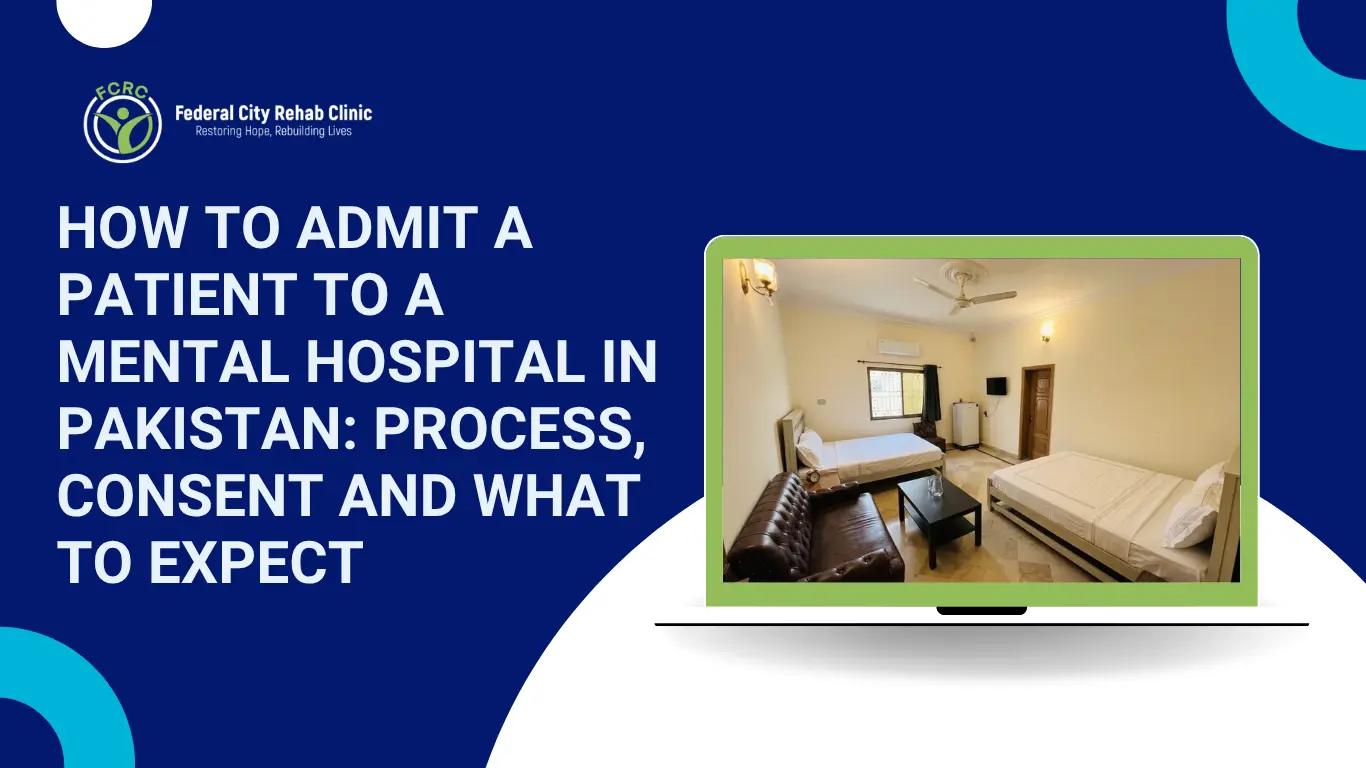
FCRC is located in Bani Gala, Islamabad, set in the private, peaceful hills away from the pressures of urban life. The facility provides private residential rooms, dedicated therapy spaces, outdoor grounds, quiet prayer facilities, and structured daily programming. It is designed for recovery, not just containment.
Confidentiality
Every patient at FCRC is protected by absolute confidentiality. No information about a patient’s treatment, admission, or clinical situation is shared with any employer, institution, family member, or third party without explicit written consent. For patients who are concerned about professional or community consequences, this is not a secondary consideration. It is fundamental to how we operate.
Serving Patients from Across Pakistan
Drug addiction does not happen only in Islamabad. FCRC receives patients from every major city in Pakistan. If your family is based elsewhere, here is how treatment at FCRC works in practice.
- Lahore: A three to four hour drive or short domestic flight. FCRC’s Lahore rehabilitation guide covers transport options and what to expect.
- Karachi: A direct domestic flight to Islamabad. Our team coordinates transport from the airport directly to the facility.
- Peshawar: Approximately two hours by road. Our Peshawar rehabilitation guide covers local options and why many families prefer FCRC’s Islamabad facility.
- Rawalpindi: Less than 30 minutes from FCRC’s facility. Easily the closest major city to our Bani Gala location.
- Multan: A four to five hour drive or domestic flight. Our Multan rehabilitation guide covers the journey and what families from South Punjab should know.
Overseas Pakistanis: FCRC has a dedicated programme for Pakistani patients travelling from the UK, UAE, and other countries. Pre-admission video consultations, airport coordination, and overseas-specific aftercare planning are all available through our overseas rehabilitation programme.
Frequently Asked Questions
How long does drug addiction treatment take?
This depends on the substance, the severity of dependency, and the presence of co-occurring conditions. Medical detoxification for opioid or alcohol dependency typically takes two to four weeks. A full residential programme runs 30 to 90 days. Complex or long-term cases may require extended stays. Aftercare support continues beyond discharge. Our team will give you a clear indication after the initial assessment.
What does drug addiction treatment cost in Pakistan?
Costs vary significantly across facilities. FCRC’s programme cost depends on the length of stay, the level of clinical complexity, and the specific services required. We are transparent about costs from the first conversation. For families concerned about affordability, payment arrangements can be discussed. Our Islamabad rehabilitation centre costs guide provides further context on what families should expect when budgeting for treatment.
My family member does not want treatment. What should I do?
This is the situation most families are in when they first contact us. The desire to seek treatment often fluctuates, and the moment of openness can be brief. Our family consultation service allows you to speak with a clinician before your family member is involved, to receive guidance on how to approach the conversation, what to say, what to avoid, and how to act quickly when the window opens. Call us regardless of where your family member is in their readiness to accept help.
Is treatment at FCRC confidential?
Completely. Nothing about a patient’s admission, treatment, or discharge is shared with any third party without explicit written consent. This includes employers, educational institutions, and family members. Our facility’s location in Bani Gala provides both physical and social privacy.
Does FCRC treat female patients?
Yes. FCRC has a dedicated female rehabilitation programme with female clinical staff, separate residential facilities, and a treatment approach designed around the specific needs and circumstances of women seeking addiction treatment in Pakistan.
Can family members visit during treatment?
Yes, and in most cases we actively encourage structured family involvement. Visit arrangements are coordinated with the clinical team to ensure they support rather than disrupt the treatment process. Family therapy sessions can also be conducted via video for family members who cannot travel.
The First Step
Drug addiction is a medical condition. It has biological roots, a known clinical trajectory, and an effective treatment pathway. It is not a moral failure, a weakness of character, or something that a family should manage alone through willpower and prayer.
Recovery is possible. Millions of people around the world recover from serious drug addiction every year. The patients who walk through FCRC’s doors in crisis are not defined by how they arrived. They are defined by where they go from here.
If you are ready to talk, our team is available around the clock for a free, confidential consultation. Call us, WhatsApp us, or visit contact us to get in touch. You do not need to have everything figured out before you make that call. That is what we are here for.