My Family Member in the UK Has an Addiction: Can They Get Treatment at FCRC Pakistan?
Author: Abrar Ahmad | CEO & Clinical Psychologist, Federal City Rehab Clinic
Doctoral-level psychologist specialising in adolescent and young adult substance use, family systems therapy, and evidence-based addiction treatment. Founder of FCRC Pakistan’s youth rehabilitation programme.
You already know something is wrong. Maybe you have known for a long time. You have watched someone you love change in ways that frightened you. You have had conversations that went nowhere. You have lain awake at three in the morning wondering what to do next.
You are reading this because you live in the UK and your son, daughter, husband, brother, or parent is struggling with addiction. And you are wondering whether getting them treatment in Pakistan is actually possible, or whether it is just a desperate idea that sounds better than the alternatives.
It is not just possible. For many British Pakistani families, it is the single best decision they ever made.
This article answers every question you are likely to have. What treatment at FCRC actually involves. How to get a family member there from the UK. What it costs compared to treatment here. And why so many families in exactly your situation have chosen Bani Gala, Islamabad over anything available closer to home.
Why British Pakistani Families Are Turning to Pakistan for Rehab
The answer is not one thing. It is several things that, together, make the case almost unarguable for families who understand the full picture.
The NHS is not designed for residential addiction treatment
The UK Government’s own substance misuse statistics for 2024 to 2025 confirm that over 310,000 adults accessed drug and alcohol treatment services in England in 2023 to 2024. That is a system under enormous pressure. The NHS provides community-based outpatient support, GP referrals, and some medically supervised detox. What it does not routinely provide is residential rehabilitation. Inpatient rehab through the NHS is exceptionally rare and, where available, subject to strict eligibility criteria and lengthy assessment processes. For most people with serious addiction, the NHS pathway means outpatient appointments, not a structured residential programme with round-the-clock clinical support.
Private residential rehab in the UK carries an enormous price tag
If the NHS route is not suitable, the alternative is private treatment. Fully residential rehab in the UK typically costs between £8,000 and £16,000 for a 28-day stay. Luxury facilities in London and the south-east charge considerably more, sometimes upwards of £10,000 per week. A 90-day programme, which many addiction specialists consider the minimum for complex or long-term dependency, can therefore cost between £24,000 and £48,000 in the UK. Those are not figures most families can absorb.
The privacy problem that nobody talks about openly
This is the factor that matters most to many British Pakistani families, and the one least often discussed in polite conversation. Published research from the UK into British South Asian and Muslim communities has documented what families already know instinctively: the fear of being seen by another community member at a UK treatment service is a powerful and real barrier to seeking help. In tight-knit Pakistani communities across Birmingham, Manchester, Bradford, and London, word travels. The thought of running into someone familiar at a clinic, or of a family member recognising your relative from a treatment centre, is not paranoia. It is a reasonable fear with real consequences.
Treatment in Pakistan removes this problem entirely. There is no community crossover. Nobody from your Bradford street or your Manchester mosque is at a facility in Bani Gala. The distance is not a drawback. For many families, it is the whole point.
Cultural and linguistic alignment
Most UK rehab facilities offer addiction treatment designed primarily for a white British patient population. The cultural dynamics of Pakistani family life, the role of izzat and community expectation, the specific shame landscape that British Pakistani patients navigate, the importance of Islamic values in recovery, and the wish to be understood rather than explained to, are rarely central to UK treatment programmes. At FCRC, they are not afterthoughts. They are built into the structure of how we work.
What Happens When You Call FCRC from the UK
The process begins with a phone call or a WhatsApp message. That is it. You do not need a referral. You do not need to have all the answers. You do not need your family member to be ready or even aware that you are making the call.
Step 1: Confidential family consultation
The first conversation is for you, the family member. Our clinical team will listen to what you have observed, ask questions about the situation, and give you a clear picture of what treatment options are appropriate. This conversation is completely confidential. Nothing is shared with anyone without your explicit consent.
Many families call us at a point of crisis, having tried everything they can think of. Others call early, when they have a feeling something is wrong but are not yet certain. Both are the right time to call.
Step 2: Clinical assessment
If treatment at FCRC is the right direction, we arrange a formal clinical assessment. For families in the UK, this can begin remotely via a secure video consultation before any travel is arranged. Our consultant psychiatrists and clinical psychologists conduct a thorough evaluation covering the nature and severity of the addiction, the presence of any co-occurring mental health conditions, medical history, and the right level of care.
Step 3: Travel and admission coordination
Once the decision is made, our team coordinates the practical side of the journey. This includes advising on the right time to travel, what to tell your family member before they go, how to handle the journey, what to bring, and what the arrival process looks like. For families who are concerned about their relative refusing to travel, we provide guidance on how to have that conversation and, where appropriate, family intervention support.
Islamabad is a direct flight from London, Manchester, and Birmingham. The journey is straightforward. Our team can arrange airport coordination so that your family member is met and transported directly to the facility.
Step 4: Treatment begins
Admission at FCRC involves a comprehensive medical assessment, a personalised treatment plan, and a structured induction into the residential programme. From the first day, your family member is under 24-hour medical and clinical supervision. You will be kept informed at every stage, within the boundaries of your family member’s consent and the requirements of clinical confidentiality.
What Treatment at FCRC Actually Looks Like
FCRC is not a basic detox facility. It is a full-spectrum psychiatric and addiction rehabilitation centre, led by board-certified psychiatrists and doctoral-level psychologists, and affiliated with the UNODC, IHRA, and the Pakistan Psychological Association.
Medical detoxification
For most patients, the first phase of treatment involves medically supervised detoxification. This is clinically critical for anyone dependent on alcohol, opioids, benzodiazepines, or other substances where sudden cessation carries medical risk. At FCRC, detox is conducted under internationally recognised clinical protocols with 24-hour nursing and psychiatric oversight. It is not safe to attempt detox without medical supervision, and our team ensures that this phase is managed with both clinical precision and patient comfort.
Dual diagnosis treatment
The majority of patients presenting with serious addiction also carry an underlying mental health condition. Research published in the British Journal of Psychiatry has consistently documented the link between addiction and co-occurring depression, anxiety, PTSD, and personality disorders. FCRC’s dual diagnosis programme treats both conditions simultaneously rather than sequentially, which produces significantly better long-term outcomes.
Individual and group psychotherapy
The psychological heart of FCRC’s programme is structured daily therapy. Patients receive individual sessions with a dedicated therapist as well as participation in group therapy. Our clinical team is trained in Cognitive Behavioural Therapy (CBT), Dialectical Behaviour Therapy (DBT), Motivational Interviewing, and trauma-focused modalities. The approach is evidence-based and adapted to the cultural context of Pakistani patients, including those who have grown up between two cultures.
Family therapy and involvement
Addiction does not happen in isolation and neither does recovery. FCRC’s family therapy programme actively involves family members, with appropriate consent, in the treatment process. For UK-based families, this means structured video sessions with your family member’s therapist, psychoeducation about the nature of addiction and recovery, and support in understanding how to respond when your loved one returns home. The family is not a bystander in this process. The family is part of the treatment.
The physical environment
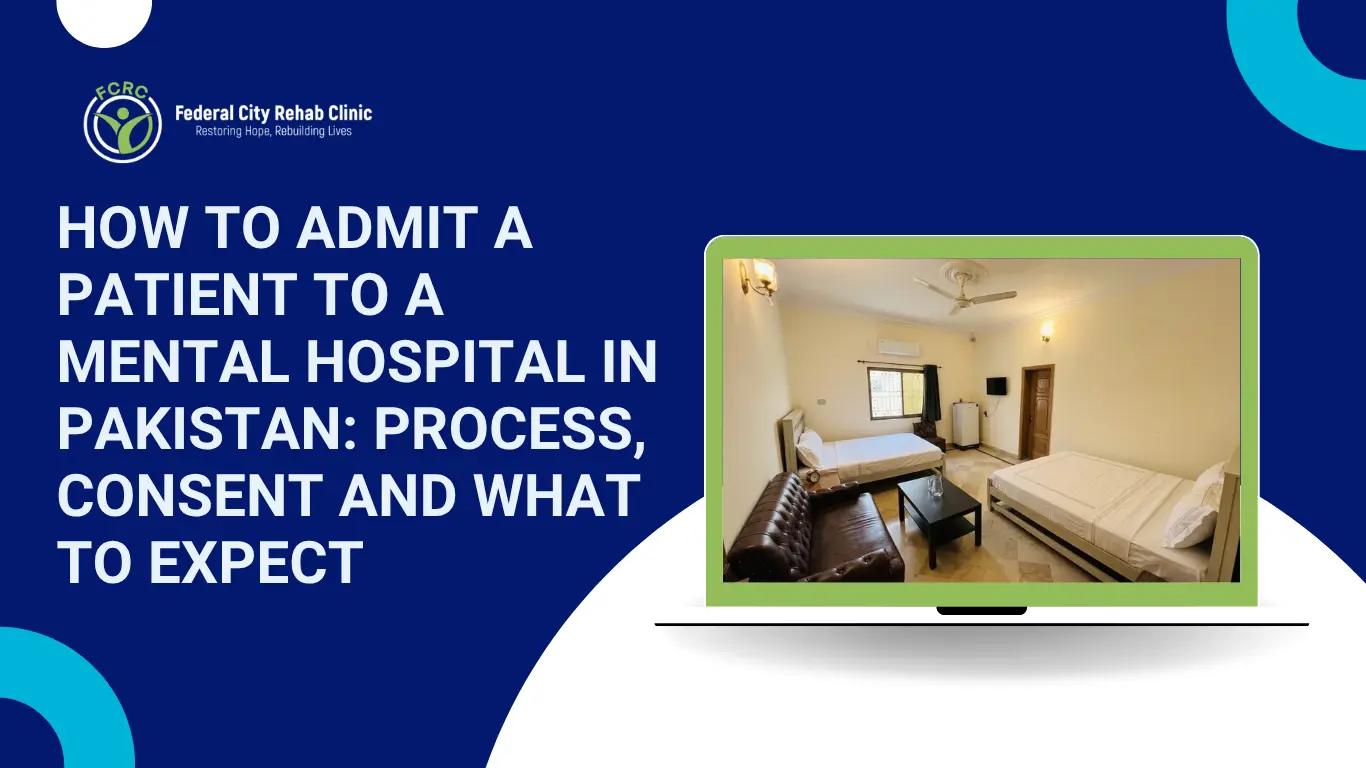
FCRC’s facility is set in the hills of Bani Gala, Islamabad, away from the pressures and triggers of urban life. The setting is private, secure, and deliberately calm. Patients have access to outdoor spaces, structured recreational activities, and quiet prayer facilities. The environment is designed to support recovery, not just contain it.
Addressing the Concerns Every UK Family Has
The questions below are the ones we hear most often from families calling from the UK. They are good questions and they deserve direct answers.
Is it safe to send my family member to Pakistan for treatment?
Yes. FCRC is a fully registered, clinically accredited facility with board-certified medical staff on site around the clock. Islamabad is a stable and navigable city. The facility in Bani Gala is secure, private, and purpose-built for residential treatment. Families who have made this decision consistently describe their relief at the level of clinical professionalism and the quality of the environment.
What if my family member refuses to go?
This is the most common fear. The motivation to seek help often fluctuates and the moment someone agrees to treatment can pass quickly if not acted upon. Our team has extensive experience supporting families through the process of helping a resistant loved one reach a decision. We can advise you on how to approach the conversation, what language to use, what to avoid, and how to create the right conditions for agreement. A family consultation with our clinical team is a good first step even when your family member has said no.
Will my family member be isolated from us during treatment?
Not at all. Communication with family members is structured and supported as part of the treatment process. In the early stages, a period of reduced contact is sometimes clinically recommended to allow the patient to settle and focus. After that, regular contact is actively encouraged. For UK families, this typically means scheduled video calls, updates from the clinical team at agreed intervals, and the option to visit the facility for family therapy sessions.
How does aftercare work when they return to the UK?
Aftercare planning begins before discharge, not after. FCRC’s clinical team works with each patient and their family to establish a concrete aftercare plan for when they return to the UK. This includes identifying appropriate local support services in the UK such as NA or AA, establishing a structure for the first weeks at home, and providing the family with guidance on what to watch for and how to respond. Ongoing outpatient support from FCRC is available remotely via video consultation for patients who have completed residential treatment.
What about my family member’s job or studies in the UK?
Confidentiality is absolute. Nothing about your family member’s treatment is shared with employers, universities, or any third party without their explicit written consent. From an employment perspective, a period of absence for health reasons is protected under UK law. Many of our patients from the UK complete treatment and return to their careers and studies without any professional disruption. Our team can advise on how to manage the practical aspects of a leave of absence.
Is treatment at FCRC appropriate for women?
Yes. FCRC has a dedicated female rehabilitation programme with female clinical staff, separate residential facilities, and a treatment approach specifically designed around the needs of women, including the cultural and family dimensions that are particular to Pakistani and British Pakistani women. Privacy and gender-appropriate care are not optional additions in our female programme. They are the foundation of it.
The Cost Comparison: UK vs FCRC Pakistan
Private residential rehabilitation in the UK costs between £8,000 and £16,000 for a standard 28-day programme. A 90-day stay, which is commonly recommended for serious or long-standing addiction, can therefore reach between £24,000 and £48,000 before any additional costs are considered. Many families simply cannot sustain this level of expenditure regardless of how much they want to help.
Treatment at FCRC is a fraction of that cost. FCRC delivers clinically equivalent, and in many respects superior, specialist care at a cost that makes a full treatment programme genuinely accessible rather than a theoretical option.
The cost difference between a 90-day UK programme and a 90-day programme at FCRC can be substantial enough to cover return flights, accommodation for a family visit, and aftercare support with money remaining. For families weighing this decision, the financial comparison is not a minor consideration. It is often the factor that makes comprehensive treatment actually possible.
Contact our team directly for a full breakdown of programme costs and what is included. We do not publish exact figures online because treatment is individually tailored, but we will give you a complete and transparent picture in your first conversation.
A Note on Timing
Addiction does not improve while a family waits. The moment when a person is ready to accept help is often brief and unpredictable. When that window opens, having a clear plan already in place makes the difference between acting and missing it. Do not wait for a crisis to make the call.
Research consistently shows that early intervention in addiction produces substantially better outcomes than treatment sought at a point of severe crisis. The longer a dependency continues, the more entrenched it becomes and the more complex the treatment it requires. Calling FCRC before things reach their worst point is not premature. It is the right time.
We understand that taking this step feels enormous. We also know that families who make this call consistently describe it, in retrospect, as the most important thing they did.
Quick Reference: What UK Families Need to Know
How do I make the first contact?
Call or WhatsApp us on 0330 1454321. You can also contact us through the website. A clinical team member will respond promptly. The first conversation is free, confidential, and carries no obligation.
Can I speak to a clinician before my family member is involved?
Yes. The family consultation is specifically designed for this. You can speak with our team, explain the situation, and receive clinical guidance before your family member knows anything is happening.
How quickly can admission be arranged?
Once a clinical assessment is complete and the decision to proceed is made, admission can typically be arranged within days. We do not maintain a waiting list in the NHS sense. When the time is right, we move quickly.
Do you offer a payment plan?
Yes. We understand that the cost of treatment, even at FCRC, represents a significant family decision. Our team will discuss payment options with you in confidence during your first consultation.
Can the family visit during treatment?
Yes, and in many cases we actively encourage it. Family visits are coordinated with the clinical team to ensure they support rather than disrupt the treatment process. For UK-based families, we can also arrange family therapy sessions via video if travel to Pakistan is not possible.
You Have Already Done the Hardest Part
Searching for help is not easy. Admitting that someone you love needs treatment, and then actually looking for it, takes more courage than most people recognise. The fact that you are reading this article means you have already cleared the highest barrier.
FCRC exists for families exactly like yours. Families who are carrying something heavy, who have tried to manage alone for too long, and who need to know that there is a place, staffed by people who understand, that can help.
We are available twenty-four hours a day, seven days a week. The first call costs nothing. Whatever the situation and however complicated things have become, please reach out. Visit our contact page or call us directly.