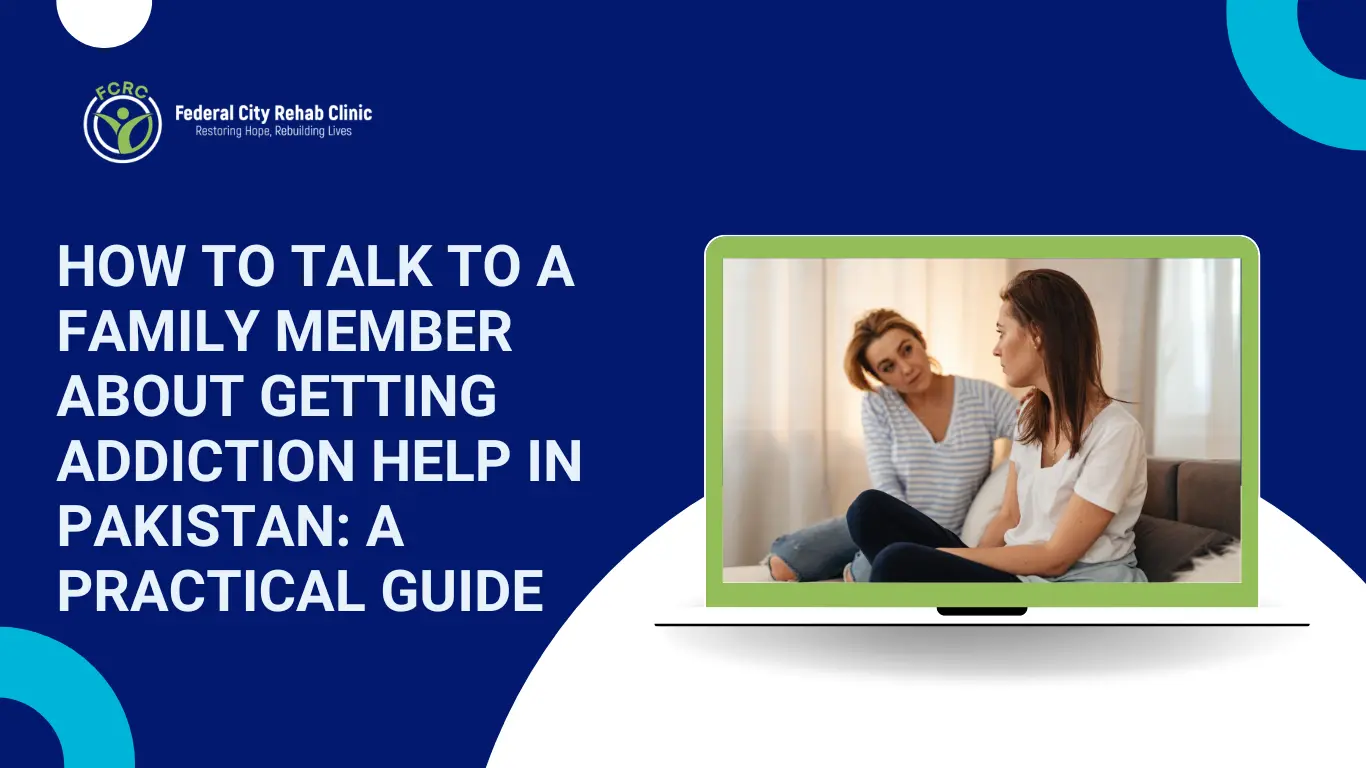
How to Talk to a Family Member About Getting Addiction Help in Pakistan: A Practical Guide
Author: Abrar Ahmad | CEO & Clinical Psychologist, Federal City Rehab Clinic
Doctoral-level clinical psychologist specialising in addiction treatment, family systems therapy, and culturally sensitive rehabilitation. Founder of FCRC’s national programme.
You have been rehearsing this conversation in your head for months. Maybe longer. You have started it and stopped it a dozen times. You have picked the moment and then let it pass. You have told yourself to wait until things get worse, until they are ready, until you find exactly the right words.
The right words for covincing someone to get addiction help do not exist. But the right approach does. And understanding it can be the difference between a conversation that opens a door and one that closes it permanently.
This guide is written for the Pakistani family member who is carrying the weight of someone else’s addiction alone. It is practical and honest. It does not pretend that this is easy. And it is rooted in what the clinical evidence, and our experience at Federal City Rehab Clinic, actually tells us about what works.
Why Addiction Help Conversation Is So Hard in Pakistan
The barriers to talking about addiction within Pakistani families are specific and real. Research on help-seeking barriers in Pakistan involving 3,500 participants across five cities identified social defamation, personal shame, prohibition by family, and fear of treatment as the dominant barriers. These are not abstract cultural forces. They are the exact fears that prevent the person who needs help from accepting it, and the family member from offering it.
The izzat factor
In Pakistani family culture, a family member’s behaviour reflects on the entire family. Addiction is not seen as a medical condition. It is seen as a shameful secret that, if exposed, damages the family’s standing in the community. This means that the conversation about getting help is not just a conversation between two people. It carries the weight of everything the family fears others will think.
The belief that it is a moral failing
Research consistently documents that Pakistani families overwhelmingly interpret addiction through a moral and religious lens rather than a medical one. The person with the addiction is seen as weak, sinful, or lacking willpower. This framing makes the addicted person feel judged rather than supported, and makes them less likely to accept help rather than more.
The fear that talking about it makes it real
Many families have been managing in silence for so long that the thought of saying it out loud feels catastrophic. As long as it is not spoken, there is a version of events in which it is not quite as serious as it is. The conversation collapses that version. This fear is completely understandable and completely counterproductive.
Before the Conversation: What You Need to Understand First
The most common mistake families make is approaching the addiction conversation without understanding what they are actually dealing with. Addiction is a medical condition with biological roots. It is not stubbornness. It is not a choice. The person you love is not refusing to stop because they do not care about the family. They are not stopping because they cannot, without clinical support.
This distinction matters enormously in how you approach the conversation. If you go in believing that your family member is choosing this, your tone will carry judgement, and judgement closes doors. If you go in understanding that they are ill, your tone will carry concern, and concern opens them.
PMC research on family dynamics and addiction in Pakistan notes that family communication style is one of the most significant factors in whether a young person with addiction accepts help or retreats further into secrecy. The way the family talks about addiction shapes whether the person feels safe enough to receive help.
How to Have the Addiction Help Conversation: A Step-by-Step Approach
Step 1: Choose the moment carefully
Do not have this conversation during a crisis. Do not have it when you are angry, when they are intoxicated, or in the aftermath of an incident. These are the moments when emotions are highest and defences are strongest. Nothing useful comes from a conversation that begins with blame and ends with a door slamming.
Choose a calm, private moment when both of you are physically present and there are no time pressures. Early in the day, when they have not yet used, is often better than the evening. The setting matters. This is not a conversation for a crowded room or a family gathering.
Step 2: Lead with love, not accusation
The opening of this conversation determines everything that follows. There is a significant clinical difference between these two openings:
“I know what you have been doing and it has to stop. You are destroying this family.”
“I have been worried about you for a long time and I love you. I want to understand what you are going through.”
The first is an accusation. The second is an invitation. Even if everything in you wants to say the first one, the second one is the only one that has a chance of working.
Do not open with a list of everything they have done wrong. Open with what you feel. I am worried. I love you. I am scared for you. These are not weaknesses. They are the only language that breaks through the wall of shame and defensiveness that addiction builds.
Step 3: Listen more than you speak
Once you have expressed your concern, stop talking and listen. This is harder than it sounds. You will want to interrupt, correct, argue with what they say. Do not. The goal of this first conversation is not to win an argument or extract an admission. The goal is for the other person to feel heard enough to stay in the conversation.
Ask questions rather than making statements. What has things been like for you lately? Is there something that has been difficult that I do not know about? How long have you been feeling this way? Questions open the space for honesty. Statements close it.
Step 4: Avoid these specific mistakes
- Ultimatums on first attempt: “Either you get help or I am leaving” may feel necessary but rarely produces what you want. It corners a person who is already cornered. Save ultimatums for later, if they become necessary.
- Comparing them to others: “Look at your brother, he does not have this problem” is deeply counterproductive. It adds humiliation to an already shame-saturated situation.
- Bringing up every past incident: This is not a reckoning. It is a conversation about the future. Stay in the present.
- Making it about the family’s reputation: “What will people say” is the wrong argument at this moment. It reinforces the shame that drives continued use rather than reducing it.
- Trying to solve everything in one conversation: This is very unlikely to be the last conversation you need to have. Accept that. The goal today is connection, not resolution.
Step 5: Introduce the idea of help gently
Once the conversation has opened and you feel that there is some genuine contact between you, introduce the possibility of professional help. Not as a demand. As an offer.
“I have been reading about the kind of support that is available for people going through what you are going through. Would you be willing to just have one conversation with someone who understands this? You do not have to commit to anything. Just one phone call.”
One phone call is a much smaller ask than going to rehab. Getting agreement on one phone call is a significant achievement. Take it.
What to Do When They Say No
They will probably say no. At least the first time. This is not failure. It is part of the process.
Research on the stages of change in addiction recovery describes a well-established pattern: most people move through several stages before they are genuinely ready to accept help. The Transtheoretical Model of behaviour change identifies pre-contemplation, contemplation, preparation, action, and maintenance as the typical stages. A person who says no today may be in pre-contemplation or contemplation. The conversation you are having plants a seed that moves them toward the next stage. It is not wasted.
After they say no, do not disappear into silence or anger. Maintain the connection. Return to the conversation in a few days or weeks. Each time you return to it calmly and with love, you reinforce that help is available and that you are not going anywhere.
When to Seek Professional Guidance Before Having the Conversation
If any of the following apply, we strongly recommend speaking with a clinician before attempting the conversation yourself:
- Your family member has a history of violence or unpredictability.
- They are in acute crisis or withdrawal.
- Previous conversations have ended in severe conflict.
- You are concerned they may harm themselves if confronted.
- You do not know the extent of what they are using.
FCRC offers a confidential family consultation service specifically for this situation. You can speak with one of our clinicians, explain the situation, and receive practical, personalised guidance on how to approach the conversation with your specific family member. This costs nothing and carries no obligation. Many families find that one conversation with our team gives them the clarity and confidence they needed.
After They Agree: Moving Quickly
The window in which someone agrees to seek help can be brief. When it opens, move quickly. Have a plan ready before the conversation so that you are not searching for options in the days that follow.
Know which facility you are considering before you have the conversation. Have the phone number ready. Know roughly what the process involves. When your family member says yes, even tentatively, the next step should be a phone call to the clinical team, ideally within the same day.
If you are considering FCRC, our team is available around the clock at 0330 1454321. We can walk you through the process, answer your family member’s questions directly if they are willing to speak with us, and arrange an assessment at a time that works.
A Note on Protecting Yourself
Supporting a family member through addiction is one of the most emotionally exhausting experiences a person can go through. Pakistani families often bear this entirely internally, with no external support, driven by the need to maintain the family’s appearance of wholeness.
You are allowed to need support too. FCRC’s family therapy service supports family members throughout and after a loved one’s treatment. You do not need to carry this alone any more than they do.
Frequently Asked Questions
What if they promise to stop on their own?
This is one of the most common responses and one of the most heartbreaking, because it gives the family hope that is rarely fulfilled. For anyone with physical dependency, stopping on their own is not just difficult. It can be medically dangerous. Accept the promise as a sign of willingness and redirect it toward getting clinical support rather than managing alone. “That is wonderful. Let us find out together what the safest way to do that is.”
Should I involve other family members?
This depends entirely on the family dynamic. In some families, a united expression of concern from several members is powerful and supportive. In others, it can feel like an ambush that causes the person to shut down completely. If you are considering involving others, speak with a clinician first about how to approach this in a way that supports rather than overwhelms.
What if they get angry?
Anger is a common response to this conversation, particularly in the early stages. It does not mean you have done it wrong. Stay calm. Do not respond to anger with anger. If the conversation escalates beyond what is manageable, step back and let it rest. You can return to it. What matters is that you remain a steady, non-judgemental presence in their life.
How many times should I try?
Keep trying. The research evidence on this is clear: consistent, compassionate family engagement is one of the strongest predictors of eventual treatment acceptance. Each conversation, even the ones that seem to fail, moves the person incrementally toward readiness. You are not failing when they say no. You are building the foundation for when they say yes.
The conversation you are afraid to have is the one that can change everything. You do not have to have it perfectly. You just have to have it with love