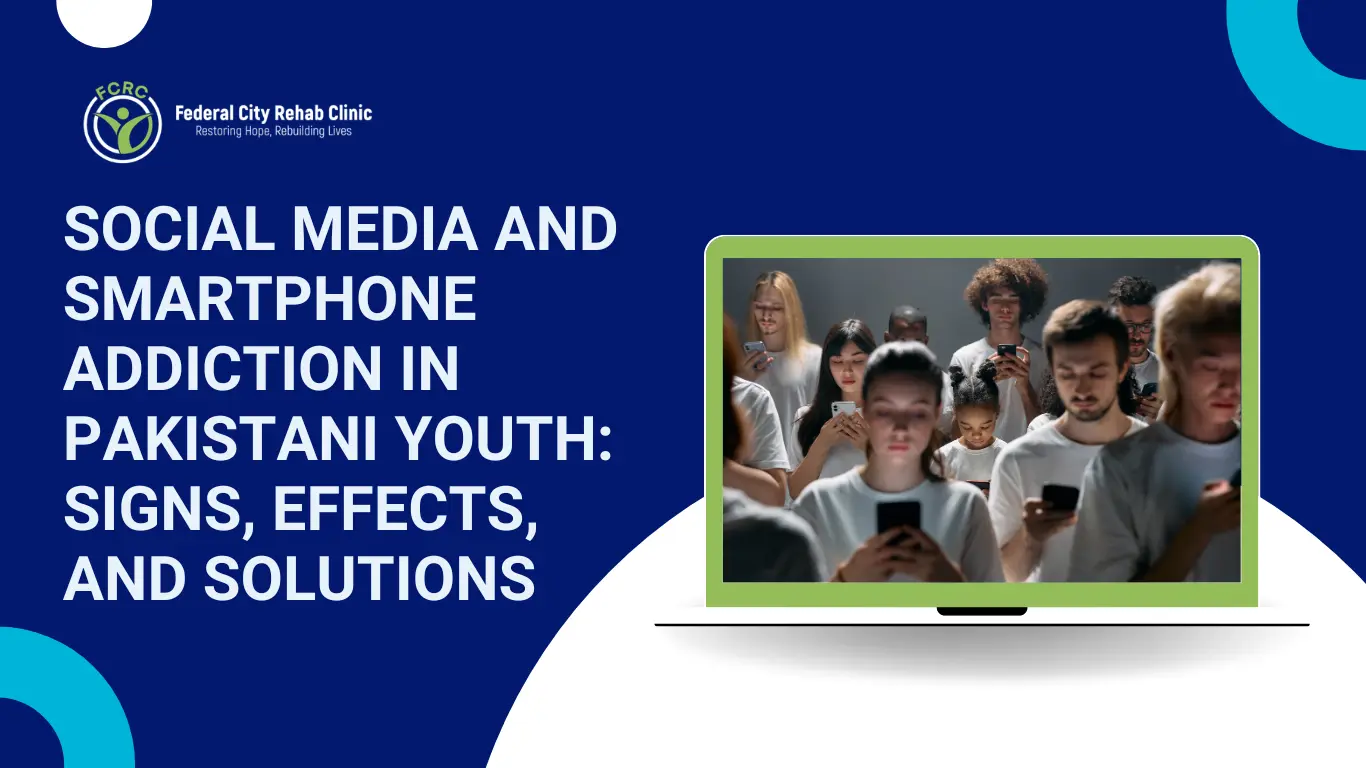
Social Media and Smartphone Addiction in Pakistani Youth: Signs, Effects, and Solutions
Author: Abrar Ahmad | CEO & Clinical Psychologist, Federal City Rehab Clinic
Doctoral-level clinical psychologist with over a decade of specialisation in addiction treatment and evidence-based rehabilitation at FCRC Islamabad
A parent notices that their teenager is on their phone until two or three in the morning. Another watches their child abandon friendships, hobbies, and studies in favour of hours of scrolling, gaming, or watching content. A third finds that any attempt to set limits on screen time is met with disproportionate anger, anxiety, or emotional collapse.
These are not isolated incidents. They are part of a pattern that clinicians are seeing with increasing frequency across Pakistan, and which the research literature is beginning to describe with the same frameworks used for substance addiction.
Smartphone and social media addiction is a real clinical phenomenon. It is not a matter of children being lazy or parents failing to set boundaries. It involves measurable changes in brain chemistry, recognisable patterns of compulsive behaviour, and genuine consequences for mental health, academic functioning, and social development. And it is reaching a point in Pakistan where families need honest, practical information about what it is, how to recognise it, and what to do about it.
Is smartphone addiction real?
This is a reasonable question. The word addiction carries clinical weight, and applying it to phone use can seem like an overstatement.
The clinical picture is more nuanced than a simple yes or no. Smartphone and internet use disorder is not yet classified as a formal addiction diagnosis in the same way as alcohol use disorder or opioid use disorder in all diagnostic frameworks. However, the World Health Organization has classified Gaming Disorder as a recognised condition in its International Classification of Diseases, acknowledging that compulsive digital behaviour can meet the clinical criteria for addiction. And the broader research literature on problematic smartphone and social media use consistently identifies patterns that mirror substance addiction in both their neurological basis and their behavioural presentation.
The dopamine system is central to both. Social media platforms are engineered to trigger dopamine release through notifications, likes, shares, and the unpredictable reward of new content. This is not accidental. The variable reward mechanism, in which the user does not know whether the next scroll will bring something interesting or disappointing, is the same mechanism that drives slot machine addiction and is among the most powerful behavioural conditioning tools known. Over time, the brain adapts to this constant stimulation in ways that parallel the adaptations seen with substance use, including reduced sensitivity to natural rewards, increased impulsivity, and a growing need for stimulation to feel regulated.
Whether the label addiction is applied or not, the practical reality is that compulsive smartphone and social media use causes measurable harm to a significant proportion of young people who engage in it heavily, and that it responds to the same kinds of clinical intervention used for other behavioural addictions.
The Pakistani context
Pakistan’s smartphone penetration has grown dramatically over the past decade. According to the Pakistan Telecommunication Authority, mobile broadband subscriptions have crossed 130 million, with smartphones now present in the vast majority of urban households and increasingly common in semi-urban and rural areas as well.
Alongside this growth, access to social media platforms, streaming services, online gaming, and messaging applications has become near-universal among Pakistani youth. The average young person in an urban Pakistani household is spending a significant portion of their waking hours on a screen, often with little parental oversight of content or duration.
Several factors make the Pakistani context particularly worth examining.
Academic pressure combined with digital escape is a common pattern. Young people navigating demanding educational environments, family expectations, and limited healthy recreational options find digital environments provide an easy, immediately available form of relief and stimulation. What begins as a reasonable outlet can become a compulsive pattern.
Social comparison on platforms like Instagram and TikTok has a measurably negative effect on self-esteem and mental health, particularly among adolescent girls. The curated, filtered presentation of other people’s lives creates a persistent sense of inadequacy that drives further engagement with the platform in search of validation, which compounds the problem.
Online gaming, particularly multiplayer games with social and competitive elements, creates its own dependency patterns. The combination of social belonging, achievement systems, and the open-ended nature of online games makes them particularly difficult to disengage from voluntarily.
Parental awareness and digital literacy in Pakistan has not kept pace with the speed of the technology’s spread. Many parents are managing a problem they do not fully understand, with tools that were designed for a different era of child development.
Signs of social media and smartphone addiction in young people
Recognising problematic use requires distinguishing between heavy use, which is common and not necessarily harmful, and compulsive use that is causing functional impairment. The following signs point toward the latter.
Loss of control over use:
The young person consistently uses their phone or social media for longer than they intended. They make repeated unsuccessful attempts to cut down or stop. Periods of reduced use feel genuinely distressing rather than mildly uncomfortable.
Preoccupation:
When not using their phone, the person is thinking about it, anticipating getting back to it, or feeling agitated and restless. The phone occupies mental space that interferes with other activities including face-to-face conversation, study, and sleep.
Withdrawal symptoms when the phone is taken away:
This is one of the most clinically significant indicators. When the phone is removed or restricted, the young person experiences a response that goes beyond ordinary frustration. Anxiety, anger, emotional dysregulation, physical restlessness, inability to concentrate on anything else, and in some cases tearfulness or panic are all part of the withdrawal picture. The intensity of this response is disproportionate to the situation and reflects genuine neurological dependency on the stimulation the device provides.
Tolerance:
The amount of time needed on the device to feel satisfied or regulated increases over time. What once provided a sense of relaxation or entertainment for an hour now requires three or four hours to achieve the same effect.
Displacement of other activities and relationships:
Hobbies, sports, in-person friendships, family time, and academic work are progressively abandoned or neglected in favour of screen time. The digital environment becomes the primary or exclusive arena for social engagement and entertainment.
Continued use despite negative consequences:
The young person continues to use excessively despite clear negative consequences including failing grades, deteriorating health, family conflict, and loss of friendships. When confronted with these consequences, they become defensive, dismissive, or temporarily remorseful before returning to the same patterns.
Sleep disruption:
Late-night phone use interfering with sleep is near-universal in heavy users. The blue light emitted by screens suppresses melatonin production and makes sleep onset harder. Beyond the physiological effect, the stimulating content of social media and gaming keeps the nervous system aroused when it should be winding down. Chronic sleep deprivation compounds every other effect of compulsive phone use, significantly worsening mood, concentration, impulse control, and mental health.
Mood dependence on online activity:
The young person’s mood is disproportionately influenced by what happens online. Likes, comments, followers, and online social dynamics produce intense emotional highs and lows. Offline life feels comparatively flat, uninteresting, or meaningless.
Effects on mental health
The relationship between heavy social media and smartphone use and mental health difficulties in young people is one of the most researched areas in contemporary psychology. The picture that has emerged is concerning.
Depression and anxiety are consistently associated with heavy social media use in adolescents and young adults, particularly among girls. Research published in the journal JAMA Pediatrics found significant associations between social media use and depressive symptoms, even after controlling for other variables. The mechanisms include social comparison, cyberbullying, sleep disruption, and the displacement of face-to-face social connection that supports mental health.
Attention and concentration difficulties are documented consequences of sustained heavy smartphone use. The constant context-switching, the brevity of content, and the immediate gratification of digital environments trains the brain away from sustained, effortful attention. Young people who have spent years in high-stimulation digital environments frequently report significant difficulty sitting with a book, a task, or a conversation that does not offer instant reward. This has direct consequences for academic performance.
Social anxiety can both drive social media use and be worsened by it. Young people who find face-to-face interaction difficult turn to digital communication as a lower-risk alternative, which can reduce their tolerance for real-world social demands still further. The paradox is that heavy social media use, despite being nominally social, often deepens isolation.
Body image and self-esteem are significantly affected, particularly for girls and young women, by exposure to the heavily filtered and curated imagery that dominates Instagram and similar platforms. The clinical literature on the relationship between Instagram use and disordered eating, body dissatisfaction, and appearance-related anxiety has grown substantially in recent years.
Aggression and emotional dysregulation are associated with excessive gaming in particular. The intensity of gaming environments, the social conflicts that arise within online gaming communities, and the frustration of competitive losses can all contribute to heightened aggression and difficulty regulating emotion in offline contexts.
When does it become a clinical concern?
Not every young person who uses their phone heavily has an addiction. The clinical threshold is reached when use is compulsive rather than habitual, when genuine attempts to stop or reduce fail, when withdrawal symptoms are present, and when functioning is meaningfully impaired across multiple areas of life.
The distinction matters because the intervention required is different. A young person who is using their phone a lot but is sleeping adequately, maintaining relationships, performing at school, and able to put the phone down when asked has a habit that may benefit from better boundaries but does not require clinical treatment. A young person who is failing academically, sleeping three to four hours a night, has abandoned all offline friendships, becomes acutely distressed when their phone is taken away, and has made repeated unsuccessful attempts to change their behaviour is describing a clinical picture that warrants professional assessment.
Co-occurring mental health conditions are common in this population. Depression, anxiety, ADHD, and social anxiety disorder are all frequently present alongside compulsive digital use, sometimes as contributing causes and sometimes as consequences. Assessment should include both the digital use pattern and the broader mental health picture.
What parents can do
Parents navigating this issue are often caught between two ineffective approaches: either doing nothing because they are not sure how serious it is, or reacting punitively in ways that produce conflict without producing change.
Neither works well. What does work is a combination of clear structure, genuine engagement, and professional support where the pattern has moved beyond what family intervention alone can address.
Have the conversation without making it a confrontation. Approach the topic from a place of genuine curiosity and concern rather than accusation. Ask what the young person enjoys about their online life, what it gives them, and what they feel when they are not on their phone. The answers will tell you a great deal about what need is being met and therefore what alternative or support is needed.
Set clear, consistent limits and follow through. Screen-free times, particularly around meals and in the hour before sleep, provide structure without being punitive. The key is consistency. Limits that are negotiated away or not enforced teach the young person that they are not real.
Replace, do not just remove. Restriction without replacement creates a vacuum. If the phone is providing stimulation, social connection, entertainment, and a sense of achievement, removing it without offering alternatives to meet those needs will produce resistance and relapse into heavy use. Structured activities, physical exercise, and investment in offline social relationships all play a role.
Model the behaviour you want to see. Parental phone use is one of the most significant environmental factors in a young person’s relationship with technology. A parent who is constantly on their own phone while asking their child to put theirs down has a credibility problem that will undermine every other intervention.
Seek professional support if the pattern has become entrenched. If the young person has made repeated unsuccessful attempts to change, if withdrawal responses are severe, if mental health is significantly affected, or if family conflict over technology has become a persistent feature of home life, a clinical assessment is the appropriate next step.
Treatment for smartphone and social media addiction
Treatment for compulsive digital use in young people follows a similar framework to other behavioural addictions, adapted for the specific characteristics of the technology and the developmental stage of the patient.
Clinical assessment is the starting point. A thorough assessment establishes the pattern and severity of use, the functional impairment it is causing, and whether co-occurring mental health conditions are present. This forms the basis for a treatment plan tailored to the individual.
Cognitive Behavioural Therapy (CBT) is the primary evidence-based intervention. It addresses the thought patterns that drive compulsive use, including social comparison, fear of missing out, and the belief that the online environment is more rewarding or safer than offline life. It builds practical skills for managing urges, tolerating discomfort without reaching for the phone, and restructuring daily routines to support reduced and healthier use.
Motivational work is particularly important with adolescents, who frequently do not share the concern about their phone use that their parents have and who may not be internally motivated to change. Motivational Enhancement Therapy works with the young person’s own values and goals rather than imposing external ones, which produces more durable engagement with treatment.
Family therapy addresses the family system around the young person’s use, including parental responses that may inadvertently reinforce the pattern, family communication dynamics, and the practical management of technology within the home. Recovery is significantly more likely when the family environment actively supports it.
Treatment for co-occurring conditions is integrated where relevant. Depression, anxiety, ADHD, and social anxiety all require direct clinical attention alongside the work on digital use. Our Dual Diagnosis Program provides integrated psychiatric and psychological treatment for patients presenting with both a behavioural concern and a co-occurring mental health condition.
Our Youth and Adolescent Program is specifically designed for young people, with an approach adapted to their developmental stage, the nature of their difficulties, and the importance of family involvement throughout the treatment process.
When to seek help
If you are a parent who recognises a significant pattern of compulsive phone or social media use in your child, and if that pattern is affecting their sleep, mental health, academic performance, or relationships, a clinical assessment is the right first step.
You do not need to wait until the situation reaches a crisis point. Early intervention produces better outcomes and is significantly less disruptive than waiting until the problem has become entrenched.
Our clinical team is experienced in assessing and treating behavioural addictions in young people, including the co-occurring mental health conditions that frequently accompany them. We work with the young person and the family together, because recovery from any addiction, including behavioural addiction, is a family process.
Contact us today for a confidential assessment, WhatsApp us to reach out privately, or call us to speak with a member of our clinical team directly.
Frequently Asked Questions
At what age should I be concerned about my child's phone use?
Problematic smartphone and social media use can develop at any age from early adolescence onward, but the risks are greatest and the consequences most significant for children under 16 whose brains are still in critical developmental stages. The younger the child and the heavier the use, the more seriously the pattern should be taken.
How many hours of screen time per day is too much?
There is no single threshold that applies to all young people. What matters more than raw hours is whether use is compulsive, whether it is displacing sleep and other important activities, and whether the young person can disengage voluntarily. A young person spending four hours a day on their phone who sleeps well, maintains friendships, and performs at school is in a different category from one spending the same amount of time but failing all three.
Can social media cause depression in teenagers?
The research consistently shows an association between heavy social media use and depressive symptoms in adolescents, particularly girls. The relationship is bidirectional — depression can also drive increased social media use as a form of avoidance. In clinical practice, the two frequently co-occur and need to be assessed and addressed together.
My child says all their friends are on their phones all the time. How do I argue with that?
The fact that a behaviour is common does not mean it is harmless. You can acknowledge that your child is right about what their peers are doing while holding the position that your concern is about the effect on them specifically, not about what everyone else does. Focusing the conversation on observable effects, such as sleep, mood, and energy, rather than screen time as an abstract concept tends to be more productive.
Is gaming addiction the same as social media addiction?
They share the same underlying neurological mechanisms and the same clinical framework, but the specific patterns and triggers differ. Gaming addiction tends to involve stronger elements of achievement, competition, and social belonging within the gaming community. Social media addiction tends to involve social validation, social comparison, and fear of missing out more centrally. Both are real clinical concerns and both respond to similar treatment approaches.
Where can I get help for smartphone or social media addiction in Pakistan?
Our Youth and Adolescent Program at Federal City Rehab Clinic in Islamabad provides assessment and treatment for behavioural addictions including compulsive smartphone and social media use, alongside any co-occurring mental health conditions. Contact us, WhatsApp us, or call us to arrange a confidential assessment.
Conclusion
Dual diagnosis is not an exotic or unusual presentation. It is the clinical norm for serious addiction in Pakistan, made more severe by the country’s significant mental health treatment gap. Patients with addiction whose underlying psychiatric conditions remain unrecognised receive incomplete treatment, and the relapse that often follows is not random failure but predictable clinical consequence.
What changes outcomes is integrated treatment. Comprehensive psychiatric assessment that explicitly looks for co-occurring conditions. Coordinated clinical care that addresses both the addiction and the mental illness within the same programme. Evidence-based therapy that targets both dimensions. Medication management where indicated for the psychiatric condition, alongside addiction-focused work. Aftercare that accounts for the management of both conditions over the long term.
Federal City Rehab Clinic was designed to provide exactly this kind of integrated treatment. For families whose previous treatment attempts have not produced lasting recovery, and for families starting this process for the first time who want to ensure they are getting genuinely comprehensive care, FCRC’s clinical model is built around the reality of how serious addiction actually presents in Pakistan.
If you would like to begin a confidential conversation about your family’s situation, reach out to our admissions team through our contact page. We are available 24 hours a day, every day of the year, with no pressure, no judgement, and complete privacy.