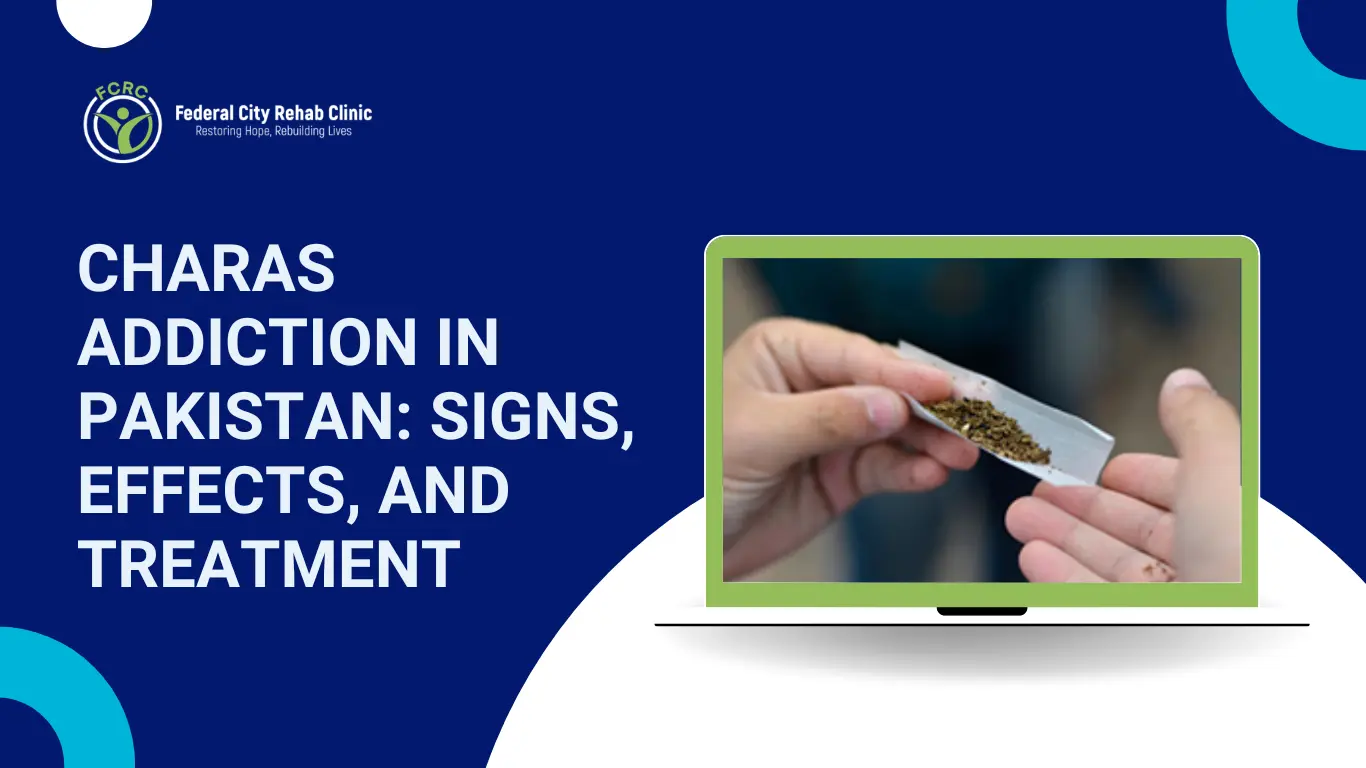
Charas Addiction in Pakistan: Signs, Effects, and Treatment
Author: Dr. Kifayat Ullah | Public Health Physician, Federal City Rehab Clinic
MBBS, MPH. Specialist in addiction medicine, medically supervised detoxification, and public health aspects of substance use disorder in Pakistan. Author of FCRC’s clinical detoxification protocols.
Charas is one of the most widely used drugs in Pakistan, yet it rarely gets the serious attention it deserves. Families dismiss it as harmless. Young people use it thinking it is natural, traditional, and safe. And by the time the addiction becomes visible, it has often been building quietly for years.
Understanding what charas actually is, what it does to the brain and body, and why it is genuinely difficult to stop using are the first steps toward getting the right help.
What is charas? The English explanation
Charas is a form of cannabis resin produced by hand-rolling the flowers and leaves of the cannabis plant. In English, it belongs to the same family of substances as hashish. Both are concentrated forms of cannabis made from the resin of the plant rather than the dried leaves or buds typically associated with marijuana or ganja.
The critical difference between charas and the dried cannabis most commonly known in the West is potency. Charas is far more concentrated. The psychoactive compound responsible for the drug’s effects is tetrahydrocannabinol, or THC, and it is present in much higher quantities in charas than in ganja. A person smoking charas is receiving a significantly stronger dose of THC than someone smoking loose cannabis leaves.
In Pakistan, charas is produced primarily in the northern mountainous regions including Khyber Pakhtunkhwa, Gilgit-Baltistan, and areas along the Afghan border, and is distributed widely across urban centres including Islamabad, Rawalpindi, Lahore, and Karachi. It is typically smoked in a chillum or mixed with tobacco and rolled into a cigarette. Among younger users, it is increasingly consumed through pipes and improvised devices.
The substance is deeply embedded in certain cultural and social contexts, which makes it harder for users and families to recognise its use as a problem. This cultural normalisation is one of the main reasons charas addiction in Pakistan goes unaddressed for so long.
How charas affects the brain
Charas acts on the brain’s endocannabinoid system, a network of receptors involved in regulating mood, memory, appetite, pain perception, and the experience of reward. THC binds to these receptors and artificially floods the system with dopamine, producing the feeling of relaxation, euphoria, and altered perception that users seek.
With repeated use, the brain begins to adapt. It reduces its own production of natural endocannabinoids and downregulates the number of receptors available. Over time, the user needs more charas to achieve the same effect. This is the physiological basis of tolerance and it is the beginning of addiction.
The brain regions most affected by sustained charas use include the hippocampus, which governs memory and learning, and the prefrontal cortex, which is responsible for decision-making, impulse control, and the ability to assess consequences. Heavy, long-term charas use measurably impairs functioning in both areas. This is not a temporary effect that disappears after stopping. For heavy users, particularly those who began in adolescence, some cognitive changes can persist for months or years after quitting. The World Health Organization recognises cannabis use disorder as a significant public health concern, with heavy users at the greatest risk of lasting neurological impact.
Signs of charas addiction
Because charas use is common and often social, many families struggle to distinguish ordinary recreational use from dependency. The following signs indicate that use has moved beyond casual and into addiction.
Increased tolerance. The person needs noticeably more charas than before to feel the same effects. What started as a small amount is now a much larger daily quantity.
Inability to stop. The person has tried to reduce or quit but has been unable to do so for more than a few days. Attempts to cut down consistently fail.
Withdrawal symptoms. When charas is not available, the person becomes irritable, anxious, restless, or unable to sleep. They may lose their appetite or experience physical discomfort. These symptoms typically begin within 24 to 48 hours of stopping and peak within the first week.
Continued use despite consequences. The person is aware that charas is affecting their relationships, work, studies, or health and continues to use it anyway. The pull of the drug overrides rational judgement.
Social and functional withdrawal. The person loses interest in activities, relationships, and responsibilities that were previously important. Their world begins to narrow around obtaining and using charas.
Secrecy and financial changes. Money goes missing. The person becomes defensive or evasive about their whereabouts. They spend increasing amounts of time with a smaller circle of people, often other users.
Motivational impairment. This is one of the most commonly reported effects by families. A previously active, engaged person becomes passive, disinterested, and difficult to motivate. This is sometimes misattributed to depression or laziness when it is actually a direct neurological effect of chronic THC exposure.
Charas addiction in adolescents and young adults
The risk of developing a charas addiction is substantially higher when use begins in adolescence. The brain continues developing until the mid-twenties, and THC has a measurably greater impact on a developing brain than on a mature one. Research cited by the National Institute on Drug Abuse consistently shows that people who begin using cannabis before the age of 18 are four to seven times more likely to develop a dependency than those who begin as adults.
In Pakistan, charas use among young men, particularly in urban centres and university environments, has increased significantly over the past decade. The availability of charas has grown, the price has dropped relative to other substances, and its social normalisation makes it an easy first step into drug use.
Parents often notice the signs first. A sudden drop in academic performance, withdrawal from family, changes in sleep patterns, and a shift in social circles are all worth taking seriously. The earlier an intervention happens, the better the outcome. Our Youth and Adolescent Programme is designed specifically for young people whose drug use began early and whose treatment needs differ from those of adult patients.
Physical health effects of long-term charas use
The health consequences of heavy, sustained charas use extend beyond the brain.
Respiratory damage is one of the most direct physical consequences. Charas is most commonly smoked, and smoke regardless of its source damages the respiratory system. Chronic bronchitis, persistent cough, and increased susceptibility to respiratory infections are common among long-term users. The risk is heightened when charas is mixed with tobacco, which is standard practice in Pakistan.
Cardiovascular effects are significant and often overlooked. THC raises the heart rate and causes short-term changes in blood pressure. For people with underlying heart conditions, heavy use carries a genuine cardiac risk. Among younger users without pre-existing conditions, these effects are typically mild during use but accumulate over time with heavy consumption.
Mental health impact is the area of greatest concern. Sustained heavy use of high-potency cannabis is associated with a significantly elevated risk of psychosis, particularly in individuals with a personal or family history of psychiatric illness. The relationship between high-potency cannabis and psychotic disorders including schizophrenia is well-established in the research literature. Anxiety and depression are also common consequences of long-term charas use, and the picture is often complicated. People use charas to manage anxiety and then find that the drug is making their anxiety worse.
Sleep disruption is near-universal among heavy users. While charas initially promotes sleep onset, chronic use suppresses REM sleep. Users often find they cannot sleep at all without using, and when they stop, the disruption continues for weeks before normalising.
Why charas is difficult to quit without support
Charas addiction is a medical condition, not a failure of willpower. The changes that occur in the brain with sustained use are physiological. Quitting is genuinely difficult, and the difficulty is not a character flaw.
Withdrawal from charas, while not life-threatening in the way that alcohol or opiate withdrawal can be, is genuinely uncomfortable and is one of the primary reasons people relapse. The irritability, anxiety, insomnia, and loss of appetite that accompany withdrawal are real physical symptoms, not imagined discomfort. Without support, most people attempting to quit charas return to use within the first two weeks, primarily to relieve these symptoms.
Beyond the physical, there is the psychological dimension. For many long-term users, charas has become the primary coping mechanism for stress, anxiety, boredom, and emotional discomfort. Quitting means confronting whatever the charas was being used to suppress and doing so without the only tool the person has relied on. This is where professional psychological support becomes essential rather than optional.
The social environment compounds the difficulty further. If a person’s social circle consists primarily of other users, and if they live or work in environments where charas is routinely available, the likelihood of sustained recovery without environmental change is low.
Treatment for charas addiction
Effective treatment for cannabis addiction addresses the physical, psychological, and social dimensions together. There is no single medication that treats cannabis use disorder, though certain medications can help manage specific withdrawal symptoms such as anxiety and insomnia. The primary interventions are psychological.
Medical detoxification provides a supervised, supported withdrawal period typically lasting five to ten days, in which the body clears the drug while medical staff manage symptoms and monitor the person’s condition. For heavy, long-term users, this initial period is critical. Attempting to detox without medical support frequently fails not because the person lacks commitment but because the withdrawal symptoms become overwhelming. Our Medical Detoxification Programme is conducted under the supervision of qualified physicians and psychiatric staff.
Residential rehabilitation follows detoxification and forms the core of recovery. A structured residential programme away from the environment and social networks associated with use gives the person time and space to develop the skills, insight, and motivation needed for long-term recovery. Our Drug Addiction Treatment Programme runs for 30, 60, or 90 days depending on the individual’s needs and circumstances. The 90-day programme consistently produces the strongest long-term outcomes for individuals with moderate to severe dependency.
Cognitive Behavioural Therapy (CBT) is the most evidence-supported psychological intervention for cannabis use disorder. It works by helping the person identify the thought patterns, emotional triggers, and behavioural habits that drive their use and developing concrete alternatives. This is not a passive process. It requires engagement, practice, and honesty.
Motivational Enhancement Therapy (MET) is particularly effective in the early stages of treatment when ambivalence is high. Many people entering treatment for charas addiction are not fully convinced they have a problem, or are not sure they want to stop. MET works with this ambivalence rather than against it, strengthening the person’s own reasons to change.
Family involvement is a consistent predictor of better outcomes. Charas addiction does not happen in isolation. It affects the entire family system, and recovery is strengthened when families understand addiction, know how to support recovery without enabling continued use, and address any communication dynamics that may have contributed to the problem. Our Family Support Programme provides structured guidance for families throughout the treatment process.
Relapse prevention planning is built into every stage of treatment. Recovery is not a single event but an ongoing process. Learning to identify warning signs, manage high-risk situations, and respond to setbacks without returning to use requires deliberate preparation.
When to seek help
If you are reading this because you recognise the signs in yourself or someone you care about, that recognition itself matters. Many families wait too long, hoping the person will stop on their own or assuming the situation is not serious enough for professional help.
Charas addiction rarely resolves without intervention. The nature of the condition is that it gradually narrows a person’s capacity to make the changes needed to recover. The earlier treatment begins, the less ground needs to be recovered.
Our clinical team, including consultant psychiatrists and clinical psychologists, will work with you to understand the situation clearly and recommend the right level of support. There is no obligation and no judgement. Contact us today for a confidential assessment, or WhatsApp us if you prefer to reach out privately.
Frequently Asked Questions
Is charas the same as hashish?
Yes. Charas is a form of cannabis resin produced by hand-rolling fresh cannabis plants. Hashish is a broader term that includes charas as well as other forms of compressed cannabis resin. Both are concentrated forms of cannabis significantly more potent than dried cannabis leaves (ganja or marijuana).
Can you get addicted to charas?
Yes. Cannabis use disorder is a recognised medical condition. According to UNODC, approximately 9% of people who try cannabis will develop a dependency, but this figure rises significantly with heavy or early-onset use. Among daily charas users, dependency rates are considerably higher.
How long does charas withdrawal last?
Acute withdrawal symptoms including irritability, anxiety, insomnia, and reduced appetite typically begin within 24 to 48 hours of stopping and are most intense during the first week. Most physical symptoms resolve within two to three weeks. Psychological cravings and sleep disturbances can persist longer, particularly in heavy long-term users.
Do charas cause psychosis?
High-potency cannabis, including charas, is associated with an elevated risk of psychosis and psychotic disorders, particularly in individuals with a personal or family history of psychiatric illness and in those who began using in adolescence. The risk is dose-dependent. Heavier use over a longer period carries greater risk. This is one of the most serious long-term health consequences of sustained charas use.
What treatment is available for charas addiction in Pakistan?
Treatment options range from outpatient counselling and therapy to residential rehabilitation programmes. For moderate to severe dependency, residential treatment is consistently more effective than outpatient support alone. We offer medically supervised detoxification and 30, 60, and 90-day residential programmes at our facility in Bani Gala, Islamabad. Call us or contact us online for a confidential assessment.