Fetal Alcohol Syndrome: Risks, Signs, and What Pakistani Parents Should Know
Author: Dr. Kifayat Ullah | Public Health Physician, Federal City Rehab Clinic
MBBS, MPH. Specialist in addiction medicine, medically supervised detoxification, and public health aspects of substance use disorder in Pakistan. Author of FCRC’s clinical detoxification protocols.
Fetal alcohol syndrome is one of the most preventable causes of lifelong disability in children. It is also one of the least discussed health topics in Pakistan, where alcohol use among women is widely assumed to be rare and where the consequences of drinking during pregnancy are therefore rarely explained to families who need to hear them.
That assumption is worth examining. Alcohol use among women in Pakistan exists, even if it is less visible than among men. It exists across socioeconomic groups, in urban and rural settings, and often in contexts of secrecy that make it harder to address. And in some cases, it exists during pregnancy, with consequences for the child that are permanent and that no amount of later intervention can fully reverse.
This article explains what fetal alcohol syndrome is, what causes it, how it presents in children, and why the conversation about alcohol and pregnancy matters in the Pakistani context regardless of assumptions about prevalence.
What is fetal alcohol syndrome?
Fetal alcohol syndrome (FAS) is a condition that occurs in children who were exposed to alcohol in the womb during pregnancy. It is the most severe form within a broader group of conditions collectively known as fetal alcohol spectrum disorders (FASDs), which represent the full range of effects that prenatal alcohol exposure can cause.
FAS is characterised by three core features: distinctive facial abnormalities, growth deficiencies, and central nervous system damage that produces lasting cognitive, behavioural, and developmental impairments. The condition is permanent. There is no cure. The neurological damage caused by alcohol exposure in the womb does not repair itself as the child grows, though early diagnosis and appropriate support can significantly improve outcomes.
According to the World Health Organization, fetal alcohol spectrum disorders are among the most common preventable causes of intellectual disability and developmental impairment worldwide. They are entirely preventable through one measure: not consuming alcohol during pregnancy.
How alcohol harms the developing baby
To understand fetal alcohol syndrome, it helps to understand what happens when a pregnant woman drinks alcohol.
When alcohol is consumed, it enters the bloodstream rapidly. In a pregnant woman, it crosses the placenta and enters the fetal bloodstream at concentrations that mirror those in the mother’s blood. The fetal liver, however, is immature and cannot process alcohol at anywhere near the rate of an adult liver. As a result, alcohol remains in the fetal system for longer and at higher effective concentrations than in the mother.
The fetal brain is developing continuously throughout pregnancy, with different structures forming and maturing at different stages. Alcohol interferes with this development by disrupting cell migration, killing developing brain cells, and interfering with the formation of neural connections. The specific nature of the damage depends in part on when during the pregnancy alcohol exposure occurs, since different brain structures are vulnerable at different developmental stages.
No stage of pregnancy is safe from alcohol exposure. The first trimester is a period of particularly rapid brain development and is associated with the facial abnormalities characteristic of FAS, but exposure during the second and third trimesters also causes neurological damage. The assumption that drinking is safer later in pregnancy is incorrect.
Research published by the National Institute on Alcohol Abuse and Alcoholism confirms that there is no established safe level of alcohol consumption during pregnancy. This is the consistent position of major health authorities worldwide, including the WHO, the American Academy of Pediatrics, and the Royal College of Obstetricians and Gynaecologists.
Signs and symptoms of fetal alcohol syndrome
FAS produces a recognisable pattern of features across three domains: physical appearance, growth, and neurological function.
Distinctive facial features:
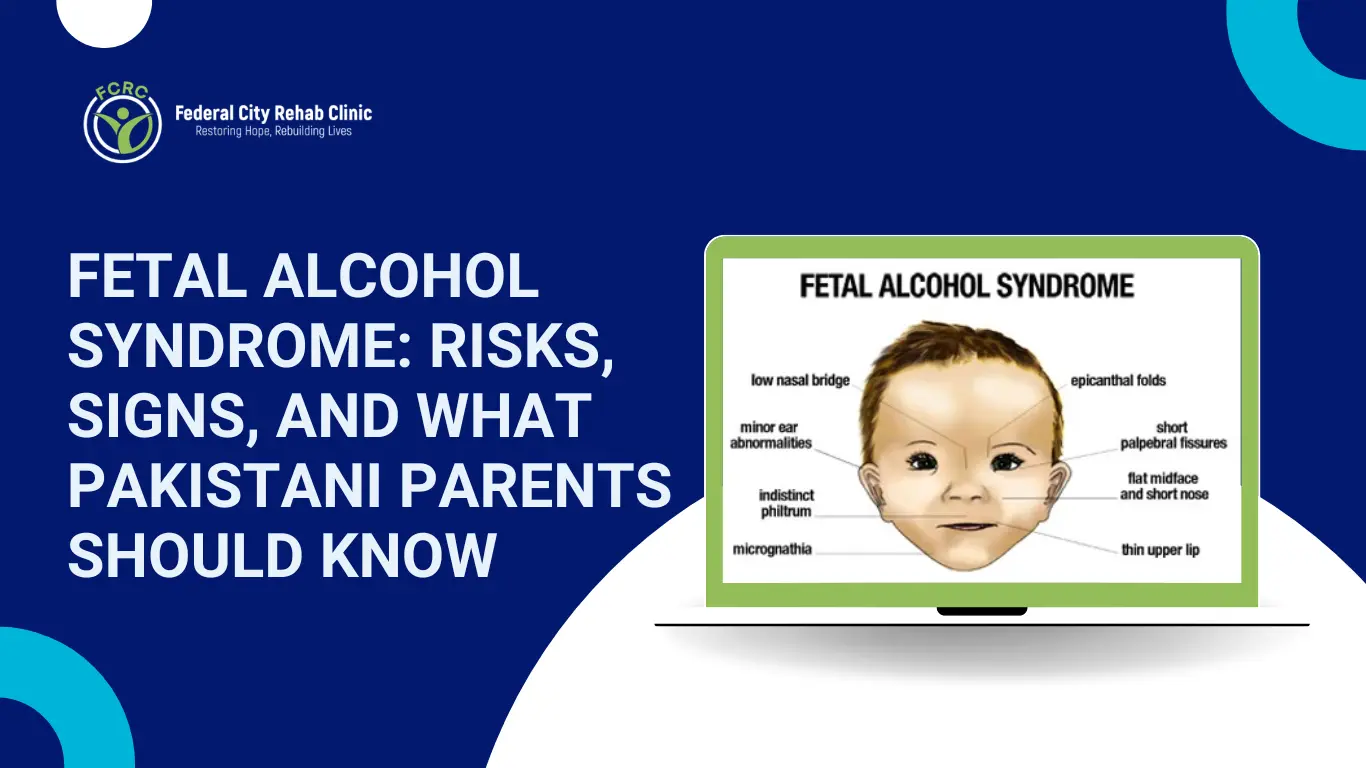
Children with FAS typically display a specific pattern of facial characteristics that reflect the timing of alcohol exposure during early fetal development. These include:
- A smooth philtrum (the groove between the nose and upper lip is absent or flattened)
- A thin upper lip
- Small eye openings (palpebral fissures)
- A flattened midface
- A small head circumference (microcephaly)
These features are not always immediately obvious and require clinical assessment for accurate identification. Not all children with prenatal alcohol exposure will display the full facial pattern, particularly those with less severe forms of FASD.
Growth deficiencies:
Children with FAS are often smaller than expected both in the womb and after birth. Low birth weight, short stature, and low weight relative to height are characteristic features that persist through childhood and adolescence.
Central nervous system damage:
This is the most significant and far-reaching aspect of FAS. The neurological damage caused by prenatal alcohol exposure manifests in a wide range of cognitive, behavioural, and developmental challenges:
- Intellectual disability ranging from mild to severe
- Learning difficulties, particularly in mathematics, reading, and memory
- Difficulty with attention and concentration, often resembling ADHD
- Poor impulse control and difficulty understanding consequences
- Difficulty with abstract thinking and cause-and-effect reasoning
- Problems with social judgment and understanding social cues
- Mood instability and emotional dysregulation
- Difficulty with daily life skills and adaptive functioning
These challenges are not the result of poor parenting, inadequate schooling, or the child’s character. They are the direct neurological consequences of alcohol exposure before birth.
Fetal alcohol spectrum disorders: the broader picture
FAS is the most severe and most recognisable diagnosis within the broader category of fetal alcohol spectrum disorders. Children who were exposed to alcohol prenatally but who do not display the full pattern of FAS features may still carry significant neurological damage that affects their development, behaviour, and learning.
Partial FAS, Alcohol-Related Neurodevelopmental Disorder (ARND), and Alcohol-Related Birth Defects (ARBD) are among the diagnoses within the FASD spectrum. Children with these conditions often do not receive an accurate diagnosis because their physical features are less distinctive, and their behavioural and cognitive challenges are attributed to other causes.
This matters in Pakistan because it means that the number of children affected by prenatal alcohol exposure is almost certainly larger than the number of diagnosed FAS cases would suggest. Many children carrying the neurological consequences of prenatal alcohol exposure are being assessed and supported for conditions other than FASD, or are receiving no support at all.
Why this matters in the Pakistani context
The assumption that fetal alcohol syndrome is not a Pakistani concern rests on the assumption that Pakistani women do not drink alcohol. This assumption is neither fully accurate nor a reason to avoid the topic.
Alcohol use among women in Pakistan is not absent. It is underreported, stigmatised, and largely invisible, which is precisely why it is dangerous. Women who use alcohol during pregnancy in a context where this behaviour carries severe social consequences are unlikely to disclose it to family members, to antenatal care providers, or to anyone in a position to help. The shame and secrecy that surround alcohol use in Pakistan do not prevent alcohol use. They prevent the conversation that could lead to support.
There is also a second dimension to this topic that is entirely independent of the question of whether Pakistani women drink. A significant number of Pakistani families, both resident in Pakistan and in the diaspora, include women from other cultural contexts, and an equally significant number of Pakistani families have members who consume alcohol for a range of reasons. The conversation about alcohol and pregnancy is relevant wherever alcohol use during pregnancy is a possibility, regardless of how common or uncommon that possibility is assumed to be.
Finally, for families dealing with alcohol use disorder in a female family member, fetal alcohol syndrome and fetal alcohol spectrum disorders are directly relevant clinical concerns if pregnancy is present or possible. Treatment for alcohol addiction in women of reproductive age must include clear guidance on alcohol and pregnancy as part of the clinical approach.
Is there a safe level of alcohol during pregnancy?
No. This is the consistent, evidence-based position of every major health authority, including the World Health Organization, the Centers for Disease Control and Prevention, and the American College of Obstetricians and Gynecologists.
No level of alcohol consumption during pregnancy has been established as safe. No trimester is without risk. No type of alcoholic drink is safer than another. The only certain protection against fetal alcohol syndrome and fetal alcohol spectrum disorders is complete abstinence from alcohol throughout pregnancy.
This position is sometimes met with the observation that many women drink small amounts during pregnancy without producing children with obvious FAS features. This is true. Not every exposure leads to FAS. The outcome depends on the amount consumed, the timing of exposure relative to fetal development, genetic factors in both mother and child, and nutritional status among other variables. But the absence of a visible outcome in one case does not establish that a safe level exists. It reflects the variability of biological outcomes, not the absence of risk.
Diagnosis and support for affected children
FAS and FASD diagnoses in Pakistan are rare not because the conditions are absent but because diagnostic awareness is low, specialist services are limited, and the stigma around alcohol means that prenatal alcohol exposure is rarely disclosed.
Diagnosis involves a multi-disciplinary assessment covering growth measurements, physical examination for characteristic features, neurodevelopmental assessment, and a history of prenatal alcohol exposure where this can be established. In some cases, a diagnosis of FASD can be made without confirmed prenatal alcohol exposure history if the clinical picture is sufficiently characteristic.
Early diagnosis matters because early intervention improves outcomes. Children with FAS and FASD benefit from:
- Educational support tailored to their specific cognitive profile
- Occupational therapy for adaptive functioning and daily life skills
- Speech and language therapy where indicated
- Behavioural support and mental health care for emotional dysregulation and impulse control difficulties
- A stable, structured, and nurturing home environment, which is one of the strongest protective factors for children with FASD
The neurological damage is permanent, but the quality of a child’s life and their functional outcomes are substantially influenced by the quality of the support they receive.
Support for mothers dealing with alcohol use disorder
A mother whose child has been affected by FAS may carry significant guilt. This guilt is understandable but rarely productive and is often compounded by the secrecy and shame that surrounded the alcohol use in the first place. Addressing alcohol use disorder with clinical support rather than concealment or condemnation is in the interest of both mother and child.
For women dealing with alcohol use disorder, effective treatment is available. Our Female Rehabilitation Program provides a gender-sensitive residential treatment environment where women can access medically supervised Medical Detoxification and structured rehabilitation in a setting that accounts for the specific pressures and contexts that female patients face in Pakistan. Our Family Support Program provides guidance for family members who are trying to support a female family member through treatment and recovery.
Treatment for alcohol addiction in women who are pregnant or planning to become pregnant is not something that can wait. The harm to a developing child from continued alcohol exposure during pregnancy is ongoing and cumulative. Seeking treatment during pregnancy is the most important protective action available.
Prevention
Prevention of fetal alcohol syndrome is straightforward in principle and requires one action: not drinking alcohol during pregnancy or when pregnancy is possible and contraception is not being used.
For women who drink alcohol and are pregnant or planning a pregnancy, the appropriate step is to seek support to stop drinking. For women who discover a pregnancy while drinking, stopping immediately reduces further risk. The damage that has occurred cannot be reversed, but continuing to drink causes additional damage. Stopping at any point during pregnancy is better than not stopping.
Healthcare providers have a role in raising awareness of alcohol and pregnancy as a clinical topic, even in contexts where alcohol use is assumed to be rare. Antenatal care that does not include any screening for alcohol use or any guidance on alcohol and pregnancy is missing a critical component of maternal and child health.
When to seek help
If you are concerned about alcohol use during a current or recent pregnancy, if you are a woman dealing with alcohol use disorder, or if you have concerns about a child’s development that may relate to prenatal alcohol exposure, professional support is available.
Our clinical team includes consultant psychiatrists and public health specialists who can provide assessment, guidance, and referral to appropriate services. There is no judgement in our approach. The focus is always on health, safety, and the best outcomes for the individuals and families we work with.
Contact us today for a confidential conversation, WhatsApp us to reach out privately, or call us to speak directly with a member of our team.
Frequently Asked Questions
Can fetal alcohol syndrome be cured?
No. The neurological damage caused by prenatal alcohol exposure is permanent and there is no cure for FAS or FASD. However, early diagnosis and appropriate educational, therapeutic, and social support significantly improve the quality of life and functional outcomes for affected individuals. The goal of support is not to reverse the damage but to maximise the person’s ability to thrive within their individual capacities.
What is the difference between fetal alcohol syndrome and fetal alcohol spectrum disorder?
Fetal alcohol syndrome is the most severe diagnosis and requires the presence of all three characteristic features: facial abnormalities, growth deficiency, and central nervous system damage. Fetal alcohol spectrum disorder is a broader term that covers the full range of conditions caused by prenatal alcohol exposure, including cases where neurological damage is present without the full facial or growth picture of FAS.
Is a small amount of alcohol during pregnancy safe?
No safe level of alcohol consumption during pregnancy has been established. The recommendation of all major health authorities is complete abstinence throughout pregnancy. The absence of a visible outcome in individual cases does not establish safety. It reflects biological variability in how prenatal alcohol exposure manifests.
At what stage of pregnancy is alcohol most harmful?
Alcohol is harmful at all stages of pregnancy. The first trimester is associated with the facial abnormalities characteristic of FAS because major facial and brain structures are forming during this period. However, the brain continues developing throughout the entire pregnancy and alcohol exposure at any stage can cause neurological damage.
How is fetal alcohol syndrome diagnosed in Pakistan?
Diagnosis requires a multi-disciplinary clinical assessment and is currently underdiagnosed in Pakistan due to limited specialist services and low awareness. If you have concerns about a child’s development that may be related to prenatal alcohol exposure, a referral to a developmental paediatrician or child psychiatrist is the appropriate starting point. Contact us and our clinical team can help guide you toward the right assessment pathway.
I am pregnant and have been drinking. What should I do?
Stop drinking immediately and seek medical support. Stopping alcohol at any point during pregnancy reduces further risk to the developing child. You should inform your antenatal care provider honestly so that appropriate monitoring can be arranged. If you are struggling to stop drinking on your own, professional support for alcohol use disorder is available and seeking it during pregnancy is the right decision. Call us or WhatsApp us for a confidential conversation with our clinical team.