Best Psychiatrist in Islamabad and Rawalpindi: How to Find the Right Help
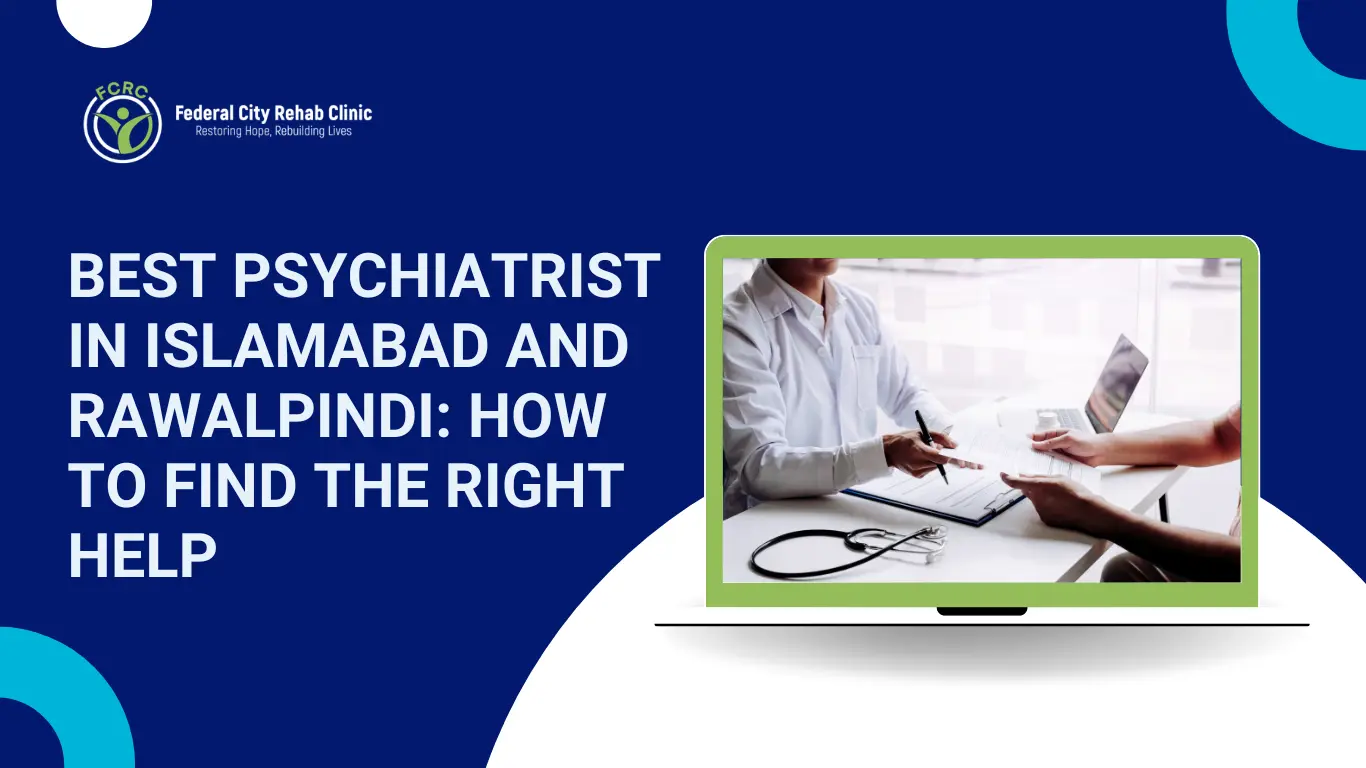
Finding a psychiatrist in Islamabad or Rawalpindi is not as straightforward as it should be. Pakistan has a significant shortage of qualified mental health professionals relative to its population size, and the process of finding the right psychiatrist, one who is genuinely qualified, experienced with your specific concern, and able to provide the level of care needed, requires knowing what to look for.
This guide is written for families and individuals in Islamabad, Rawalpindi, and the surrounding region who are looking for psychiatric help, whether for a mental health condition, an addiction, or both. It explains what a psychiatrist does, what qualifications to look for, what questions to ask, and how Federal City Rehab Clinic’s psychiatric team serves the twin cities and beyond.
What Does a Psychiatrist Do?
A psychiatrist is a fully qualified medical doctor who has completed specialist postgraduate training in psychiatry. In Pakistan, this means an MBBS degree followed by residency training and the Fellowship of the College of Physicians and Surgeons Pakistan (FCPS) in psychiatry or an equivalent postgraduate qualification.
Because psychiatrists are medical doctors first, they can do things that other mental health professionals cannot. They can prescribe and manage psychiatric medications, including antidepressants, antipsychotics, mood stabilisers, and medications used in addiction treatment. They can assess the medical dimensions of a mental health presentation, including how physical conditions, medications, and neurological factors may be contributing. And they can manage the most severe and complex mental health presentations, including psychosis, severe mood disorders, and dual diagnosis cases where addiction and mental health co-occur.
The World Health Organization defines psychiatry as a medical specialty concerned with the prevention, diagnosis, treatment, and rehabilitation of mental, emotional, and behavioural disorders. This medical framing matters because it establishes psychiatric care as a healthcare need, not a luxury or a sign of personal weakness.
A psychiatrist may work alongside a clinical psychologist, who provides the psychological therapy component of treatment, while the psychiatrist manages medication and the medical picture. This integrated approach, both disciplines working together, produces significantly better outcomes than either alone, and is the model used at Federal City Rehab Clinic.
The State of Psychiatry in Islamabad and Rawalpindi
The twin cities of Islamabad and Rawalpindi collectively represent one of the largest urban populations in Pakistan and one of the most significant concentrations of mental health need in the country. Stress, anxiety, depression, trauma, and addiction are all prevalent across both cities, driven by economic pressure, urban density, displacement, and a range of social and family stressors that characterise modern Pakistani city life.
Yet the psychiatric workforce serving this population remains seriously inadequate. According to the WHO Mental Health Atlas, Pakistan has fewer than 0.5 psychiatrists per 100,000 people, one of the lowest ratios in the region. For a combined twin city population of several million, this translates to a severe shortage of qualified psychiatric care.
The consequence is that many people who need psychiatric help in Islamabad and Rawalpindi either do not access it at all, access it through unqualified or undertrained practitioners, or wait until their condition has become severe before finding appropriate care. Early access to qualified psychiatric support produces substantially better outcomes than delayed treatment across every major mental health condition.
What to Look for in a Psychiatrist in Islamabad or Rawalpindi
Not everyone offering mental health services in Pakistan holds the qualifications that the term psychiatrist implies. Knowing what to look for protects families from spending time and money with practitioners who cannot provide the level of care needed.
PMDC Registration. Every practicing psychiatrist in Pakistan should be registered with the Pakistan Medical and Dental Council. Registration is verifiable and indicates that the practitioner has completed a recognised medical qualification. If a practitioner cannot confirm PMDC registration, they should not be consulted as a psychiatrist.
Postgraduate Psychiatric Qualification. The MBBS alone does not qualify a doctor to practice as a psychiatrist. A postgraduate qualification in psychiatry, most commonly the FCPS in psychiatry from the College of Physicians and Surgeons Pakistan, is the standard specialist credential. Some psychiatrists hold equivalent qualifications from international institutions. Ask specifically about postgraduate psychiatric qualifications, not just the MBBS.
Relevant Experience. Psychiatry covers a broad range of conditions and presentations. A psychiatrist with extensive experience in addiction and dual diagnosis is better placed to help someone with a substance use disorder alongside a mental health condition than one whose practice is focused primarily on mood disorders. Ask about experience with your specific concern.
Clinical Setting. The setting in which a psychiatrist works matters. A psychiatrist operating within a structured clinical facility, with access to nursing staff, psychologists, and a full range of treatment options, can provide a more comprehensive level of care than one working in a standalone outpatient clinic. For moderate to severe presentations, the clinical environment is part of the treatment.
Transparent Communication. A good psychiatrist explains the diagnosis, the treatment options, the rationale for any medication prescribed, and the expected timeline clearly and in terms the patient and family can understand. Vague or dismissive communication is a red flag regardless of qualifications.
Common Conditions Treated by Psychiatrists in Islamabad and Rawalpindi
Psychiatrists in the twin cities assess and treat the full range of mental health conditions. The most common presentations include:
Depression. Major depressive disorder is one of the most prevalent conditions in urban Pakistan. It is more than persistent sadness. It involves changes in sleep, appetite, energy, concentration, and motivation that significantly impair daily functioning. Moderate to severe depression typically requires both medication and psychological therapy for optimal outcomes.
Anxiety disorders. Generalised anxiety, panic disorder, social anxiety, and OCD are all common in Islamabad and Rawalpindi and all respond well to appropriate treatment combining medication where indicated with evidence-based psychological therapy. For more detail on anxiety, our blog on Anxiety Meaning in Urdu covers the full clinical picture.
Addiction and substance use disorders. Heroin, charas, ice, Xanax, Tramadol, and alcohol addiction all require psychiatric involvement in treatment, particularly where medical detoxification is needed. Psychiatric assessment of the underlying mental health conditions that frequently co-occur with addiction is essential for sustained recovery.
Dual diagnosis. The co-occurrence of addiction and a mental health condition is extremely common and requires integrated psychiatric and psychological treatment. Our Dual Diagnosis Program addresses both within a single coordinated clinical approach.
Psychosis and schizophrenia. Psychotic disorders require prompt psychiatric assessment and ongoing medication management. Early treatment significantly improves long-term outcomes.
Bipolar disorder. Bipolar disorder involves episodes of both elevated and depressed mood that require careful psychiatric management, including mood-stabilising medications and monitoring.
PTSD and trauma. Trauma is a significant driver of mental health difficulty in Pakistan, and PTSD requires specialist assessment and treatment combining psychiatric and psychological approaches.
Online Psychiatrist Services in Pakistan
Demand for online psychiatric consultations has grown significantly in Pakistan, driven partly by the shortage of local psychiatric services and partly by the stigma that can make in-person visits to a mental health facility feel difficult.
Online psychiatric consultation offers a number of genuine advantages. It removes the geographical barrier for people in areas with limited local psychiatric services. It provides a degree of privacy that some patients find makes it easier to discuss sensitive concerns honestly. And it can be a practical first step for people who are not yet ready for in-person treatment but who need initial assessment and guidance.
At Federal City Rehab Clinic, we offer initial online consultations for individuals and families who are exploring their options before committing to in-person assessment or admission. This is particularly useful for families based outside Islamabad and Rawalpindi who are considering whether residential treatment at FCRC is appropriate, as well as for overseas Pakistanis seeking guidance on how to access care for a family member in Pakistan.
Online consultation is not a substitute for in-person psychiatric assessment and treatment where these are clinically needed. For moderate to severe conditions, the depth of assessment and the range of treatment options available in person significantly exceed what is possible remotely. But as an entry point, online consultation is a valuable option and one we are glad to offer.
Why Families from Rawalpindi Choose FCRC in Islamabad
Federal City Rehab Clinic is located in Bani Gala, Islamabad, approximately 25 to 30 minutes from central Rawalpindi by road. For families in Rawalpindi seeking psychiatric and rehabilitation services, FCRC represents the closest facility of its clinical standard.
The distance from central Rawalpindi is not a barrier. Our admissions team coordinates transport for patients from across Rawalpindi and the surrounding areas, and the short journey from Rawalpindi to our Bani Gala facility means that geographical distance does not prevent access to the level of care we provide.
For patients requiring residential rehabilitation, the location in Bani Gala is clinically advantageous. It places the patient in a calm, semi-rural environment away from the urban settings, social networks, and access to substances or triggers associated with their presenting condition. Families in Rawalpindi have consistently found that the short distance from home combined with the therapeutic benefit of the Bani Gala setting makes FCRC the right choice for their family members.
FCRC’s Psychiatric Team
Federal City Rehab Clinic’s psychiatric services are led by Dr. Obaid Ullah Khan, a Consultant Psychiatrist with FCPS qualification and extensive experience in addiction psychiatry, dual diagnosis, and the full range of mental health conditions presented in the Pakistani clinical context.
Dr. Obaid Ullah Khan works within an integrated clinical team that includes Abrar Ahmad, doctoral-level Clinical Psychologist and Chartered Member of the Psychological Society of Ireland, and Dr. Kifayat Ullah, Public Health Physician. This multi-disciplinary structure means that patients receive not only psychiatric assessment and medication management but also the psychological therapy, family support, and public health perspective that comprehensive treatment requires.
For patients presenting with addiction alongside mental health conditions, this integrated team structure is particularly important. Addiction psychiatry requires the ability to assess and treat the full complexity of dual diagnosis presentations, and FCRC’s team brings the combined psychiatric, psychological, and public health expertise that this requires.
What to Expect from a Psychiatric Assessment at FCRC
A psychiatric assessment at FCRC begins with a thorough clinical interview covering the presenting concern, the history of any symptoms or substance use, the person’s physical health and medication history, their family and social context, and any previous contact with mental health services.
This assessment is conducted by our consultant psychiatrist and, where relevant, involves our clinical psychologist as well. It typically takes between one and two hours and produces a clear clinical picture of what is happening and what treatment is appropriate.
Families are welcome to attend the assessment with the patient, or to speak with our clinical team separately, particularly where the patient is a family member whose condition has made direct communication difficult. We work with families throughout the assessment and treatment process, not only with the patient.
Following assessment, our team will explain the findings clearly, discuss the treatment options, and recommend the most appropriate level and type of care. There is no obligation to proceed to treatment following assessment, and all information shared in the assessment is held in complete confidence.
When to Seek Psychiatric Help
Seek a psychiatric assessment when:
A mental health condition has been present for several weeks or more and is not improving on its own. Daily functioning, including work, relationships, sleep, or self-care, is significantly affected. The person is having thoughts of harming themselves or others. Psychotic symptoms including hallucinations or severely disordered thinking are present. A substance use disorder requires medical assessment and management. Previous attempts at treatment through other providers have not produced adequate improvement.
You do not need to be in crisis to seek a psychiatric assessment. Early assessment and treatment consistently produces better outcomes than waiting until the condition has become severe. A single consultation can provide clarity and direction even where the path forward is uncertain.
When to Seek Help
If you are in Islamabad, Rawalpindi, or anywhere in Pakistan and are looking for qualified psychiatric support, contact us today for a confidential assessment. WhatsApp us to reach out privately at any time, or call us to speak directly with a member of our clinical team. Our admissions team is available around the clock.
Frequently Asked Questions
How do I find a good psychiatrist in Islamabad?
Look for PMDC registration, a postgraduate psychiatric qualification such as FCPS in psychiatry, and specific experience with your presenting concern. Ask directly about qualifications and do not assume that any mental health professional calling themselves a psychiatrist holds the required credentials. Federal City Rehab Clinic’s psychiatric team meets all of these standards and is available for assessment by appointment.
Is there a psychiatrist in Rawalpindi?
There are psychiatrists practising in Rawalpindi. For patients requiring the combination of psychiatric assessment, psychological therapy, and residential rehabilitation where needed, Federal City Rehab Clinic in nearby Bani Gala, Islamabad, provides a higher level of integrated care than most standalone outpatient psychiatric clinics. Our admissions team coordinates transport from across Rawalpindi.
What is the difference between a psychiatrist and a psychologist in Pakistan?
A psychiatrist is a medical doctor with specialist postgraduate training who can prescribe medication. A psychologist is a mental health professional specialising in psychological assessment and therapy who cannot prescribe medication. For a full explanation, see our blog on Psychologist vs Psychiatrist in Pakistan.
Can I see a psychiatrist online in Pakistan?
Yes. FCRC offers initial online consultations for individuals and families exploring their options. Online consultation is a useful entry point and is particularly practical for people outside Islamabad and Rawalpindi or for those not yet ready for in-person assessment. Contact us to arrange an online consultation.
How long does a psychiatric assessment take?
A thorough psychiatric assessment at FCRC typically takes between one and two hours. This includes a clinical interview, review of relevant history, and where appropriate an initial psychological assessment. Following the assessment, the clinical team will provide a clear explanation of findings and recommendations.
Is psychiatric treatment confidential in Pakistan?
Yes. At Federal City Rehab Clinic, all assessments and treatment are completely confidential. Information shared during assessment and treatment is not disclosed to any third party, including family members, without the explicit consent of the patient. The only exceptions are situations involving immediate risk to the patient or others, which are governed by professional and legal obligations applicable to all healthcare providers.