Rehabilitation Center in Karachi: Why Patients Travel to FCRC Islamabad
Author: Abrar Ahmad, CEO, Federal City Rehab Clinic. Consultant Clinical Psychologist and Addiction Therapist. Chartered Member, Psychological Society of Ireland.
Karachi is Pakistan’s largest city, its commercial heart, and home to its largest concentration of medical infrastructure. For families dealing with addiction or serious mental health conditions in Karachi, this should mean abundant high-quality rehabilitation center in Karachi options. The reality is more complicated.
Karachi has rehabilitation facilities. Some are professionally run with qualified clinical teams. Others operate with limited clinical infrastructure, relying on basic counselling and motivational frameworks rather than evidence-based clinical care. The variation in quality is enormous, and the marketing of these facilities does not always reflect the clinical reality.
Some Karachi families, increasingly, look beyond their city. They travel to Islamabad. They make the journey, typically by air given the distance, to access the Federal City Rehab Clinic in Bani Gala. This is a deliberate decision made for specific reasons, and this guide explains why.
If you would like to begin a confidential conversation about your situation, FCRC’s admissions team is available 24 hours a day.
The Rehabilitation Landscape in Karachi
Karachi’s size and complexity mean that the rehabilitation options available range across a wide spectrum of quality. Public sector services, including the psychiatric department of Jinnah Postgraduate Medical Centre and other major public institutions, provide accessible care but operate under significant resource constraints. Waiting times are long. Consultation periods are brief. Specialist addiction medicine is available but oversubscribed.
The private sector in Karachi is larger than in any other Pakistani city. Some private facilities provide genuinely professional rehabilitation with qualified staff. Others operate with minimal clinical infrastructure, relying on peer support workers and basic counselling. The visual presentation of these facilities does not always indicate clinical depth.
For families evaluating Karachi options, the criteria are the same as those applicable anywhere. Clinical team qualifications. Medical detoxification capability. Dual diagnosis integration. Confidentiality protocols. Aftercare provision. The therapeutic environment. Genuine outcomes data. Applied rigorously, these criteria reveal which Karachi facilities are providing what they claim.
The Addiction Picture in Karachi and Sindh
Understanding the scale of substance use in Karachi helps frame the treatment conversation. According to the United Nations Office on Drugs and Crime, Pakistan has one of the highest rates of substance dependency in Asia, and Karachi, as the largest urban centre, accounts for a substantial share of national cases.
Heroin remains prevalent across Karachi, particularly in certain urban districts with established supply networks. ICE addiction has spread rapidly through Karachi over the past decade, with patterns now visible across all socioeconomic levels. Prescription drug dependency, particularly involving Xanax, tramadol, and pregabalin, has emerged as a major and growing problem affecting middle-class and professional populations. Alcohol dependency, less publicly acknowledged in the Pakistani context, affects a significant number of Karachi families across all socioeconomic levels.
The clinical complexity of these presentations is what makes the choice of treatment facility consequential. Severe addiction with co-occurring psychiatric conditions cannot be effectively treated by a facility without specialist psychiatric capability. Alcohol or benzodiazepine dependency requiring medically supervised detox cannot safely be managed by a facility without 24-hour medical infrastructure. The match between clinical need and clinical capability matters.
Why Some Karachi Families Choose FCRC
Families who travel from Karachi to Islamabad for rehabilitation do so deliberately. The journey is genuine, involving a flight or an extended road journey, and families do not make it casually. The reasons they make it consistently fall into three categories.
The Therapeutic Distance
For many Karachi patients, the most compelling argument for FCRC is precisely the distance. The patterns that sustain addiction are deeply tied to specific environments, social networks, and contexts. Karachi is densely connected. The neighbourhoods, the friends, the supply networks, the established routines of substance use are all immediately accessible to a patient trying to recover locally.
Recovery in Bani Gala, several hours from Karachi, provides genuine separation that no Karachi facility can match. The brain that has been conditioned to associate specific Karachi contexts with substance use is given an extended period without exposure to those cues. This is not a comfort consideration. It is a clinical advantage with real impact on outcomes.
The Clinical Standard
FCRC’s clinical team is led by professionals with international credentials. As CEO of FCRC, I hold Chartered Membership of the Psychological Society of Ireland and am a member of both the Australian Psychological Society and the Pakistan Psychological Association. The team also includes consultant psychiatrists with FCPS qualifications, clinical psychologists with M.Phil and doctoral level credentials, licensed therapists trained in evidence-based modalities, and 24-hour medical and nursing staff.
This combination of clinical depth and international credentialing is genuinely difficult to find in Karachi at comparable cost. For families specifically looking for this standard of care, the journey to FCRC often becomes the right clinical choice.
The Privacy Imperative
Karachi’s professional, business, and social networks are interconnected in ways that affect privacy meaningfully. Families dealing with addiction or mental health conditions in Karachi often worry that admission to a local facility will become known through professional contacts, extended family connections, or community networks they cannot fully control.
FCRC’s location outside Karachi solves this concern geographically. The facility is in a different city, accessed by patients from across Pakistan, with no connection to Karachi’s social or professional infrastructure. Combined with FCRC’s unconditional confidentiality protocols, this provides a level of practical privacy that is difficult to replicate locally.
What FCRC Offers Karachi Patients
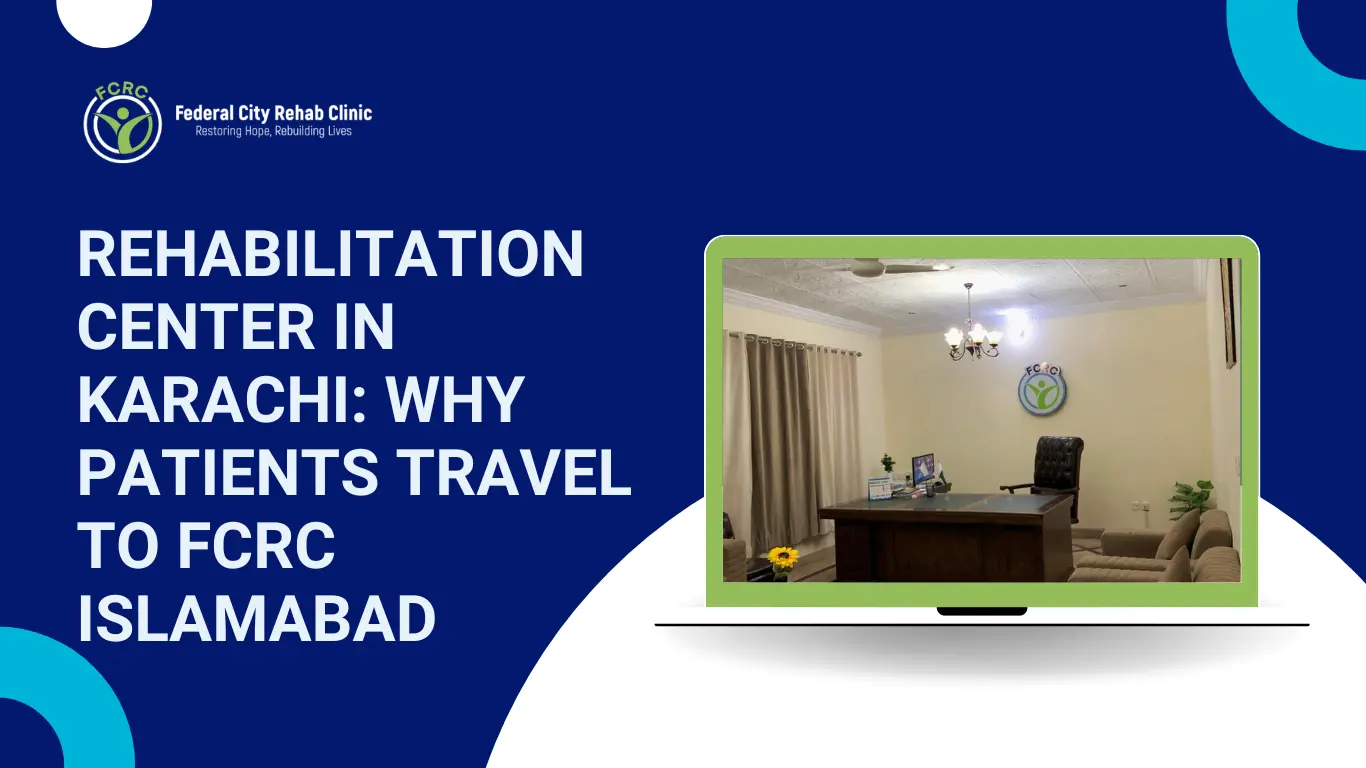
Federal City Rehab Clinic provides the full range of addiction and mental health services required by complex Pakistani cases, delivered in the calm, private setting of Bani Gala.
Drug addiction treatment covers heroin, ICE, alcohol, cannabis, cocaine, and prescription drug dependency, with specialist programmes including comprehensive ICE addiction treatment. Medical detoxification under 24-hour supervision handles the most clinically sensitive phase of recovery safely.
Mental health and psychiatric care addresses depression, anxiety disorders, bipolar disorder, PTSD, OCD, schizophrenia, and other conditions, often presenting alongside addiction in Karachi patients. Dual diagnosis treatment integrates both dimensions within a single coordinated programme.
Female rehabilitation provides fully private, all-female care staffed entirely by female clinical professionals, addressing the specific needs of Pakistani women in recovery. For Karachi families with female patients, this dedicated programme is among the most important services FCRC offers.
Inpatient residential rehabilitation is available in 30, 60, and 90-day formats, with extended care for complex cases. The residential programme immerses patients in structured daily therapeutic activity away from the contexts that sustain addiction, returning them to their lives clinically stabilised and supported by an aftercare plan.
The Practical Logistics of Travelling from Karachi
The journey from Karachi to FCRC is straightforward and supported by our admissions team.
Most Karachi patients travel by air, with daily flights connecting Jinnah International Airport to Islamabad International Airport. The flight is approximately two hours, and FCRC coordinates airport collection for patients arriving in Islamabad, with private transport directly to Bani Gala. For patients preferring road travel, the journey takes approximately 18 to 22 hours depending on the route, and FCRC can coordinate this where required.
Family visits during the residential period are scheduled in coordination with the clinical team. For Karachi families travelling for visits or family therapy sessions, the admissions team helps arrange logistics. Phone and video consultation is available throughout the treatment period for families who cannot always travel.
For Karachi patients with overseas family members, the integrated overseas family pathway allows international relatives to participate in family therapy by video and stay connected to the treatment process throughout. For overseas Pakistani families with relatives in Karachi, FCRC’s pathway is built around coordinating care across these distances.
Frequently Asked Questions
Is there a good rehabilitation center in Karachi?
Karachi has both public and private rehabilitation options ranging across a wide spectrum of quality. Some facilities are genuinely professional. Others lack adequate clinical infrastructure. Families should evaluate any local option using the same criteria they would apply to any facility, including clinical qualifications, medically supervised detox availability, dual diagnosis capability, and confidentiality protocols. For families seeking a higher standard than Karachi’s options provide, FCRC represents a clinically rigorous alternative.
How long is the journey from Karachi to FCRC?
Approximately two hours by air on direct flights between Karachi and Islamabad, plus ground transport to Bani Gala which takes around 45 minutes. Total journey time is typically three to four hours door to door. Road travel is possible but takes 18 to 22 hours and is not typically recommended.
Why would a Karachi family choose to travel to Islamabad instead of using local options?
Therapeutic distance from the environments and networks tied to addiction in Karachi. Access to clinical standards local options often cannot match. Privacy advantages of recovering outside Karachi’s interconnected social and professional circles. The therapeutic environment of Bani Gala. These factors together explain why Karachi families increasingly make this choice.
Is rehabilitation at FCRC confidential for Karachi patients?
Completely and unconditionally. No information is shared without explicit written consent. The geographic distance from Karachi adds natural privacy, with no connection between FCRC and Karachi’s professional or social networks.
Does FCRC accept female patients from Karachi?
Yes. FCRC’s dedicated female rehabilitation programme is one of the most comprehensive female-only rehabilitation programmes available in Pakistan and is regularly accessed by patients from Karachi.
Conclusion
Karachi families dealing with addiction or serious mental health conditions deserve access to genuinely professional rehabilitation. Local options vary widely in quality, and for many families, the clinically appropriate choice is to look beyond the city for a facility that can deliver the standard of care their situation requires.
For a growing number of Karachi families, that facility is Federal City Rehab Clinic in Bani Gala. The decision to travel is deliberate, made for clear clinical, environmental, and privacy reasons. The integrated approach, the internationally credentialled clinical leadership, and the therapeutic environment that Bani Gala provides combine to support outcomes that local options often cannot replicate.
If you would like to begin a confidential conversation about your situation, reach out to our admissions team through our contact page. We are available 24 hours a day, every day of the year, with no pressure, no judgement, and complete privacy.