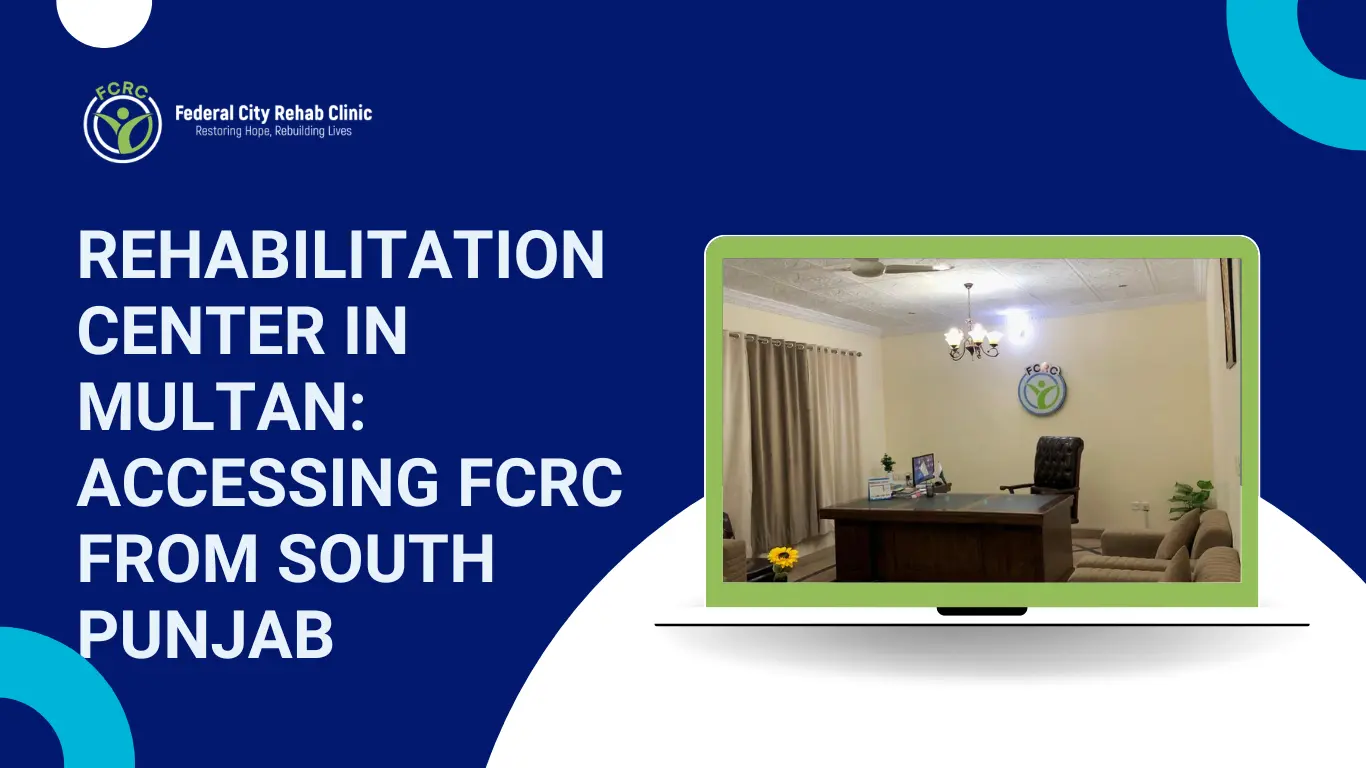
Rehabilitation Center in Multan: Accessing FCRC from South Punjab
Author: Abrar Ahmad, CEO, Federal City Rehab Clinic. Consultant Clinical Psychologist and Addiction Therapist. Chartered Member, Psychological Society of Ireland.
South Punjab has historically been under-served by Pakistan’s mental health and addiction treatment infrastructure. Multan, the largest city in the region and one of Pakistan’s oldest urban centres, has limited rehabilitation options relative to its population and the scale of the substance use challenges affecting the region. For families in Multan, Bahawalpur, Dera Ghazi Khan, and across South Punjab dealing with addiction or serious mental health conditions, the search for genuinely professional treatment often extends beyond the local area.
This guide is written for those families looking for a rehabilitation center in Multan. It covers what to look for in any rehabilitation facility you consider locally, why Federal City Rehab Clinic in Islamabad regularly admits patients from across South Punjab, and how the practical logistics of accessing FCRC from Multan and surrounding cities work in practice.
If you would like a confidential conversation about your specific situation, FCRC’s admissions team is available 24 hours a day.
The Rehabilitation Center in Multan Landscape
The rehabilitation center in Multan infrastructure is genuinely limited. Multan has some private rehabilitation facilities, but the variation in quality is significant, and the depth of clinical expertise available locally often does not match the complexity of the cases presenting for treatment.
Public sector psychiatric services exist through Nishtar Medical College and other major institutions, but these are oversubscribed and operate under significant resource constraints. Specialist addiction medicine is limited. Integrated dual diagnosis treatment, which is essential for the majority of serious addiction cases, is rarely available at the level of clinical depth required.
For families across smaller South Punjabi cities including Bahawalpur, Rahim Yar Khan, Dera Ghazi Khan, Multan suburbs, and the broader region, local options are often even more limited. The practical question becomes whether to accept inadequate local treatment or to travel to a facility with the clinical infrastructure the situation requires.
The Substance Use Picture in South Punjab
South Punjab has its own specific patterns of substance use that affect the rehabilitation conversation. According to the United Nations Office on Drugs and Crime, Pakistan as a whole faces one of the highest rates of substance dependency in Asia, and South Punjab is not exempt from this pattern.
Opium and heroin dependency have historically been significant in parts of South Punjab, with established networks affecting both urban and rural populations. ICE addiction has spread into the region over recent years, with patterns now visible in Multan and surrounding areas. Prescription drug dependency, particularly involving tramadol and benzodiazepines, has become a major concern across the region. Alcohol dependency, though less publicly discussed, affects a meaningful number of families.
The clinical complexity of these presentations is what makes the choice of treatment facility consequential. Serious addictions with co-occurring psychiatric conditions cannot be safely managed by facilities without integrated psychiatric capability. Medically dangerous detoxification cannot safely happen at facilities without proper medical infrastructure. The match between clinical need and clinical capability matters more than convenience.
What to Evaluate in Any Rehabilitation Facility
Whether you are considering options in Multan or contemplating travel to Islamabad, the criteria for evaluation are consistent. Apply them rigorously to any facility under consideration.
Ask about the qualifications of the clinical team. Consultant psychiatrists with FCPS qualifications. Clinical psychologists with M.Phil or doctoral level credentials. Therapists with specific training in evidence-based modalities. Medical and nursing staff with addiction medicine experience. Facilities that cannot or will not specify these qualifications are telling you something.
Ask about medical detoxification capability. Medically supervised detoxification requires 24-hour medical and nursing supervision, qualified medical staff, and appropriate protocols for the specific substance involved. This is essential for alcohol, benzodiazepine, opioid, and ICE detox.
Ask about dual diagnosis capability. Most serious addiction cases involve co-occurring mental health conditions. Integrated dual diagnosis treatment is essential for these cases. Facilities without proper psychiatric integration produce incomplete treatment for the majority of patients.
Ask about confidentiality protocols. The right answer is that no information is shared without explicit written consent. Ask about anonymous enquiries, communication with extended family, and documentation handling. The specifics indicate how seriously confidentiality is taken.
Ask about aftercare. Recovery does not end at discharge. Facilities with structured outpatient follow-up, continued clinical access, and personalised relapse prevention plans provide what genuine recovery requires.
Why South Punjab Families Travel to FCRC
Families who travel from Multan and across South Punjab to Federal City Rehab Clinic do so for specific, consistent reasons.
Clinical Depth That Local Options Cannot Match
FCRC’s clinical team includes consultant psychiatrists with FCPS qualifications, clinical psychologists with doctoral level credentials, and internationally credentialled clinical leadership. This combination is genuinely uncommon in Pakistani rehabilitation generally, and significantly more difficult to access in South Punjab specifically. For families looking for this standard of care, FCRC often represents the most clinically rigorous option within reasonable travel distance.
The Therapeutic Environment
FCRC’s location in Bani Gala, in the hills outside Islamabad, provides a therapeutic environment that no urban facility in South Punjab can replicate. Clean air, natural surroundings, separation from the urban contexts that often surround addiction, and the kind of physical privacy that supports genuine recovery work.
For South Punjab patients particularly, the contrast with their home environment is significant. The neighbourhoods, social networks, and contexts associated with substance use in Multan or surrounding cities are completely removed during treatment. The brain that has been conditioned to associate specific local environments with substance use is given extended time to develop new patterns.
Privacy Beyond Local Social Networks
Multan and South Punjab generally have closely interconnected family, professional, and social networks. Treatment at a local facility carries genuine risk of word reaching extended family, community contacts, or professional circles. FCRC’s location in Islamabad removes this risk entirely. Combined with FCRC’s unconditional confidentiality protocols, this provides a level of practical privacy that local options cannot match.
Integrated Comprehensive Care
The combination of medical, psychiatric, and psychological care delivered through a single coordinated programme is what produces lasting recovery for serious addiction cases. FCRC’s integrated approach addresses all dimensions of complex presentations within one programme, including dual diagnosis presentations, female-specific rehabilitation needs, and the specific clinical demands of conditions like ICE addiction.
The Practical Logistics of Travelling from Multan
The journey from Multan to FCRC is manageable and fully supported by our admissions team.
By car, the journey from Multan to Islamabad via the M-2 motorway typically takes five to six hours depending on traffic and rest stops. The motorway route is well maintained and direct. FCRC coordinates private transport from the patient’s location in Multan to the Bani Gala facility as part of the admission package where required.
By air, direct flights connect Multan International Airport to Islamabad International Airport, with the flight taking approximately one hour. FCRC arranges airport collection and private ground transport to Bani Gala from Islamabad airport. For patients from Bahawalpur, Rahim Yar Khan, and other South Punjab cities, road or air travel options can be discussed and coordinated based on individual circumstances.
Family visits during the residential period are scheduled in coordination with the clinical team. For Multan families travelling for visits or family therapy sessions, the admissions team helps arrange logistics. Phone and video consultation is available throughout the treatment period for family members who cannot always travel.
Frequently Asked Questions
Is there a good rehabilitation center in Multan?
Multan has some private rehabilitation facilities, but the depth of clinical expertise available locally often does not match the complexity of serious cases. Families should evaluate any local option using the same criteria they would apply elsewhere, including clinical qualifications, medical detox availability, dual diagnosis integration, and confidentiality protocols. For families seeking a higher standard than local options provide, FCRC in Islamabad represents the most clinically rigorous alternative within reasonable travel distance.
How long is the journey from Multan to FCRC?
By road via the M-2 motorway, approximately five to six hours. By air, approximately one hour flight time plus ground transport. FCRC coordinates transport from Multan as part of the admission package where required.
Does FCRC accept patients from Bahawalpur, Rahim Yar Khan, and other South Punjab cities?
Yes. Patients are regularly admitted from across South Punjab. Transport coordination is provided for patients travelling from outside Multan.
Is rehabilitation at FCRC confidential for Multan and South Punjab patients?
Completely. No information is shared without explicit written consent. The geographic distance from South Punjab provides additional natural privacy, with no connection between FCRC and the region’s social or professional networks.
Can family members from Multan visit during treatment?
Yes. Family visits are scheduled in coordination with the clinical team. Family therapy sessions are structured into all programmes. For family members who cannot always travel, phone and video consultation is available throughout the treatment period.
Conclusion
South Punjab’s rehabilitation infrastructure is genuinely limited relative to the scale of the substance use and mental health challenges affecting the region. For families in Multan, Bahawalpur, and across South Punjab dealing with serious addiction or mental health conditions, the search for genuinely professional treatment often extends beyond local options.
Federal City Rehab Clinic in Bani Gala provides the clinical depth, therapeutic environment, and privacy advantages that South Punjab families increasingly choose to travel for. The journey from Multan is manageable and fully supported. The standard of care delivered on arrival is what makes the journey worthwhile.
If you would like to begin a confidential conversation about your situation, reach out to our admissions team through our contact page. We are available 24 hours a day, every day of the year, with no pressure, no judgement, and complete privacy.