Opium in Pakistan: What It Is, What It Does, and Why It Is Still Destroying Lives
Before heroin, there was opium.
Long before crystal meth arrived in Pakistani cities, before Xanax became the quiet epidemic of the middle class, before ice and ketamine entered the conversation, opium was the drug that hollowed out communities across the subcontinent. It still is. Just less visibly, and in places where no one is looking very hard.
Opium is not a historical problem. It is an ongoing one. And in parts of Pakistan, particularly in rural areas and among populations overlooked by urban healthcare infrastructure, it remains the primary drug of addiction that families are actually dealing with, quietly, without much support, and often without understanding what they are facing.
افیون کیا ہے؟ What Is Opium?
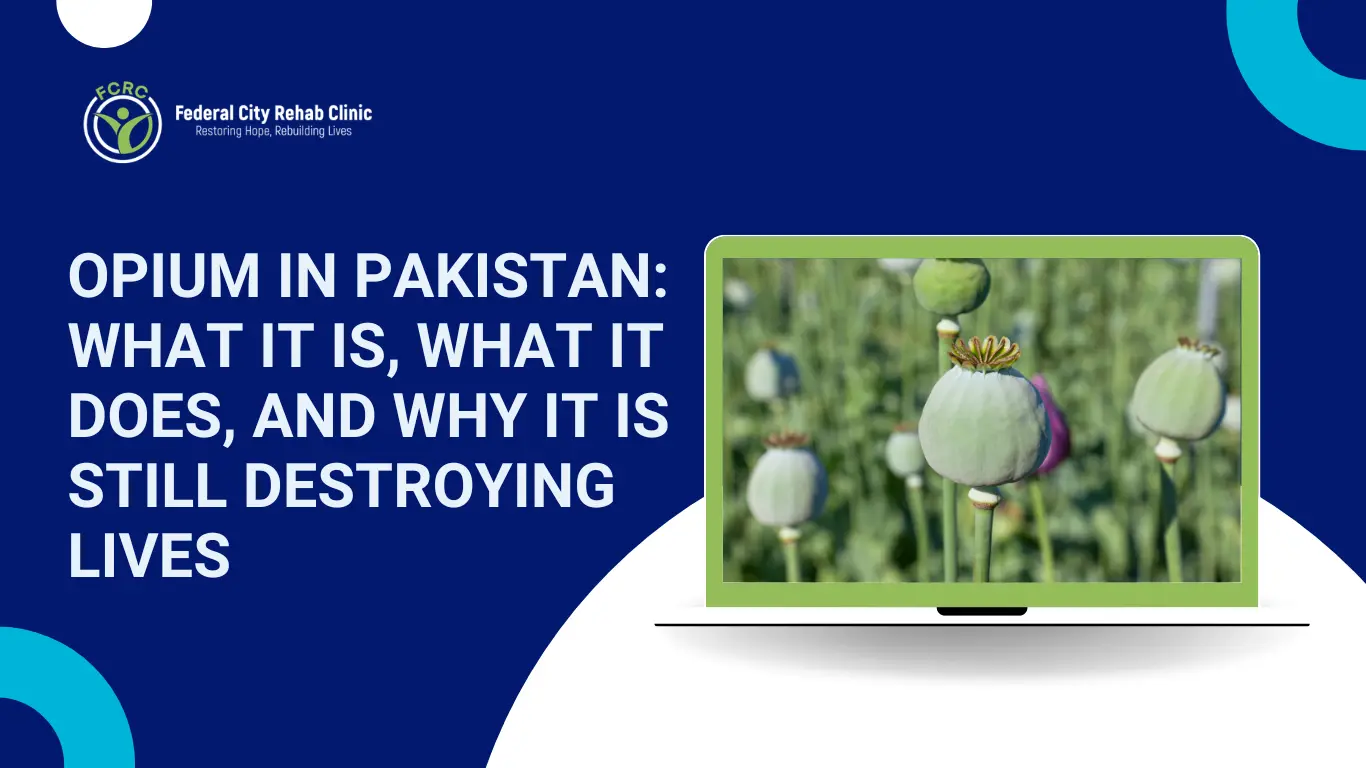
Opium is a natural substance extracted from the seed pods of the opium poppy plant, Papaver somniferum. It contains a range of naturally occurring alkaloids, including morphine and codeine, which act on the brain’s opioid receptors to produce pain relief, sedation, and intense euphoria.
Raw opium is typically consumed in South Asia by smoking it in a pipe, eating it directly in a preparation called afeem, or dissolving it in liquid. The preparation known locally as افیون (afeem) or چندو (chandu) has been part of the subcontinent’s cultural and medical landscape for centuries, which is part of what makes its addictive potential so consistently underestimated.
Morphine, heroin, codeine, Tramadol, and synthetic opioids are all derived from or chemically related to the active compounds in opium. The opium poppy is, in this sense, the source of the entire opioid drug family, from the prescribed painkiller to the most destructive street drug. Understanding opium means understanding the root of the opioid crisis.
Pakistan sits adjacent to the world’s largest opium-producing region. Afghanistan produces the vast majority of the world’s illicit opium supply, and significant quantities move through Pakistani territory on their way to international markets. Some stay. According to the United Nations Office on Drugs and Crime, Pakistan remains one of the countries with the highest rates of opioid use globally, with opium consumption concentrated particularly in the northwest and in rural areas with longstanding cultural familiarity with the substance.
The Experience and the Trap
People who have never used opioids sometimes struggle to understand why someone would continue using a substance that is destroying their life. The pharmacology of opium explains it.
When opium is consumed, its active compounds bind to opioid receptors throughout the brain and body. The immediate effect is a wave of warmth, euphoria, and physical comfort unlike almost anything else the brain can produce naturally. Pain, physical and emotional, disappears. Anxiety dissolves. The world becomes soft and manageable in a way it rarely does without the drug.
This experience is not trivial. For people living with chronic pain, with trauma, with the grinding weight of poverty and stress, the relief that opium provides is real and powerful. The brain registers this relief with extraordinary efficiency and begins to encode the substance as essential.
What follows is the trap that every opioid shares. The brain’s own opioid system, which produces natural endorphins to regulate pain and reward, is progressively suppressed as the brain adapts to the presence of the drug. Tolerance builds. The same dose produces less effect. More is needed. And when the drug is not available, the person does not simply return to their pre-drug baseline. They fall below it, into a state of physical and psychological distress that only the drug can relieve.
This is why people with opium addiction continue using despite consequences that would motivate any rational person to stop. The decision to use is not, at that point, a rational cost-benefit calculation. It is the relief of a biological need that the addiction has created.
افیون اور ہیروئن میں کیا فرق ہے؟ Opium vs Heroin
This is a question that matters clinically and practically.
Heroin is diacetylmorphine, produced by processing morphine extracted from opium. The chemical modification makes heroin cross the blood-brain barrier more rapidly than morphine, producing a faster onset and more intense initial effect. This is why heroin carries a higher addiction potential than raw opium despite being derived from the same source.
Raw opium, consumed traditionally as afeem, produces a slower onset and a longer duration. The addiction that develops with raw opium is typically slower to establish than with heroin, but it is no less complete once it has taken hold, and the withdrawal is equally real and equally difficult.
In clinical terms, both are opioid use disorders and both require the same fundamental treatment approach: medically supervised detoxification followed by sustained psychological rehabilitation. The differences lie primarily in the pharmacokinetics, the onset and duration of effect, not in the nature of the addiction or its treatment.
Who Is Actually Affected
The picture of opium addiction in Pakistan is not the one that typically comes to mind when people think about drug addiction.
It is the elderly man in a village in Khyber Pakhtunkhwa who has been eating afeem every morning for thirty years, initially for a back injury, and who cannot function without it. It is the migrant labourer who was introduced to opium by older workers on a construction site and who now spends the majority of his earnings on the substance. It is the woman who was given opium by relatives during a difficult pregnancy and who became dependent before she understood what was happening.
These are not people who sought out a drug for recreational excitement. They are people who encountered a substance in contexts that normalised its use, that provided genuine short-term relief for genuine problems, and who became trapped by its pharmacology before recognising what was happening.
The demographics of opium addiction in Pakistan skew older and more rural than the demographics of heroin, ice, or synthetic drug use. This means it is less visible to urban healthcare systems, less represented in treatment statistics, and less likely to appear in the narratives about drug addiction that circulate in Pakistani media and policy discussions. Less visible does not mean less serious.
What Withdrawal Actually Looks Like
Opioid withdrawal is not simply discomfort. For someone with established physical dependence on opium, the experience of going without the substance for 24 to 48 hours involves:
Severe muscle cramps and bone pain that some patients describe as feeling like the bones are breaking from the inside. Profuse sweating alternating with chills. Nausea and vomiting. Diarrhoea. Extreme restlessness and an inability to find any physical position that provides relief. Complete inability to sleep. Intense psychological craving that dominates every moment of attention. Anxiety and agitation that make calm impossible.
This constellation of symptoms is not something most people can manage through willpower alone, particularly without medical support in an environment where the substance is available. Every hour of withdrawal is an hour during which the decision to relieve the symptoms with a single dose would end all the discomfort immediately. Most unsupported attempts to quit fail within the first few days, not because the person does not want to stop, but because the biological drive to relieve withdrawal is that powerful.
The World Health Organization’s clinical guidelines on opioid dependence are clear that medically assisted withdrawal management, using medications to reduce the severity of withdrawal symptoms, significantly improves the likelihood of completing detoxification and engaging with subsequent rehabilitation. This is not a concession to weakness. It is a medical intervention for a medical condition.
Treatment
Recovery from opium addiction is possible. It is not quick and it is not easy, but it happens, and it happens more reliably with professional support than without.
Medical detoxification is the starting point. At Federal City Rehab Clinic, detoxification from opium and other opioids is managed under 24-hour medical and psychiatric supervision. Medications are used to manage withdrawal symptoms, reduce the peak intensity of the withdrawal period, and keep the person physically stable and safe while the drug clears from the body. This supervised period typically lasts seven to fourteen days depending on the severity and duration of the dependency.
Rehabilitation follows detoxification and is the substantive treatment. Completing detoxification only, without rehabilitation, is associated with very high relapse rates within weeks to months because it addresses the physical dependency without addressing any of the psychological, social, or environmental dimensions of the addiction. Our Drug Addiction Treatment Program provides 30, 60, and 90-day residential rehabilitation following detoxification, with the 90-day option strongly recommended for people with long-standing opioid dependency.
The rehabilitation process includes individual therapy addressing the personal history, emotional triggers, and thought patterns that have sustained the addiction. It includes group work that reduces isolation and builds peer understanding. It includes family sessions that address the family dynamics around the addiction and prepare families for the person’s return. And it includes relapse prevention planning that is specific to the individual’s triggers, environment, and risk factors.
Addressing co-occurring conditions is part of every treatment plan at FCRC. Chronic pain, which is a common driver of initial opioid use and a significant relapse risk in recovery, requires specific attention. Depression and anxiety, which both drive opioid use and are worsened by sustained opioid dependency, are assessed and treated as part of the integrated clinical approach. Our Dual Diagnosis Program manages these co-occurring conditions alongside the addiction treatment.
A Note on Stigma
Opium addiction carries a particular layer of shame in Pakistani communities because of its visibility. Unlike the private consumption of Xanax or the urban associations of ice and ketamine, opium use is often visible within communities, known to neighbours, and subject to moral judgement that extends to the entire family.
This stigma is one of the greatest barriers to treatment. Families delay seeking help not because they do not recognise the problem but because seeking help feels like publicly confirming what they have been working to conceal. The fear of what the community will say keeps people in addiction for years beyond the point at which they would otherwise have sought treatment.
Federal City Rehab Clinic operates with complete confidentiality. We are located in Bani Gala, away from the urban centres where community gossip travels fastest. Patients travel from across Pakistan, and many specifically choose FCRC because of the geographical and social distance it provides from their home communities.
Recovery does not require community approval. It requires clinical support, personal commitment, and family understanding. We provide the first and work to strengthen the other two.
Frequently Asked Questions
What is opium called in Urdu?
Opium is called افیون (afeem) in Urdu. The poppy plant from which it is derived is known as پوست (post), and preparations of raw opium consumed traditionally in Pakistan and Afghanistan are known by various regional names including chandu and post.
Is opium the same as heroin?
No, though they are closely related. Opium is the raw substance extracted from the opium poppy. Heroin is a processed derivative of morphine, which is itself extracted from opium. Heroin crosses the blood-brain barrier more rapidly than raw opium and produces a more intense initial effect. Both are opioids, both cause physical dependency, and both require medically supervised treatment for safe withdrawal.
How long does it take to become addicted to opium?
The timeline varies depending on the frequency of use, the quantity consumed, the route of administration, and individual factors including genetic vulnerability. Regular daily use of opium typically produces meaningful physical dependency within weeks to months. The cultural normalisation of afeem use in some Pakistani communities means that dependency can develop gradually without the person or their family recognising it as addiction.
Can someone recover from thirty years of opium use?
Yes. Long duration of use makes the dependency more deeply entrenched and recovery more demanding, but it does not make recovery impossible. Older patients with long histories of opioid use have achieved sustained recovery with appropriate treatment. The process requires patience, sufficient treatment duration, and attention to the full range of physical, psychological, and social factors that have built up over decades of use. Recovery at any age is possible and worthwhile.
Is opium addiction treated differently from heroin addiction?
The fundamental treatment approach is the same: medically supervised detoxification followed by sustained psychological rehabilitation. Differences exist in the pharmacokinetics of withdrawal, with opium withdrawal typically having a somewhat longer onset and duration than heroin withdrawal due to the slower absorption of raw opium. The clinical team at FCRC assesses each patient individually and designs a detoxification and rehabilitation plan appropriate to their specific substance, history, and circumstances.
Where can I get help for opium addiction in Pakistan?
Our Drug Addiction Treatment Program and Medical Detoxification Program at Federal City Rehab Clinic in Islamabad provide medically supervised treatment for opium and other opioid addictions. Contact us, WhatsApp us, or call us for a confidential assessment.