Naswar, Gutka And Paan Addiction: Harms, How To Quit And Treatment In Pakistan
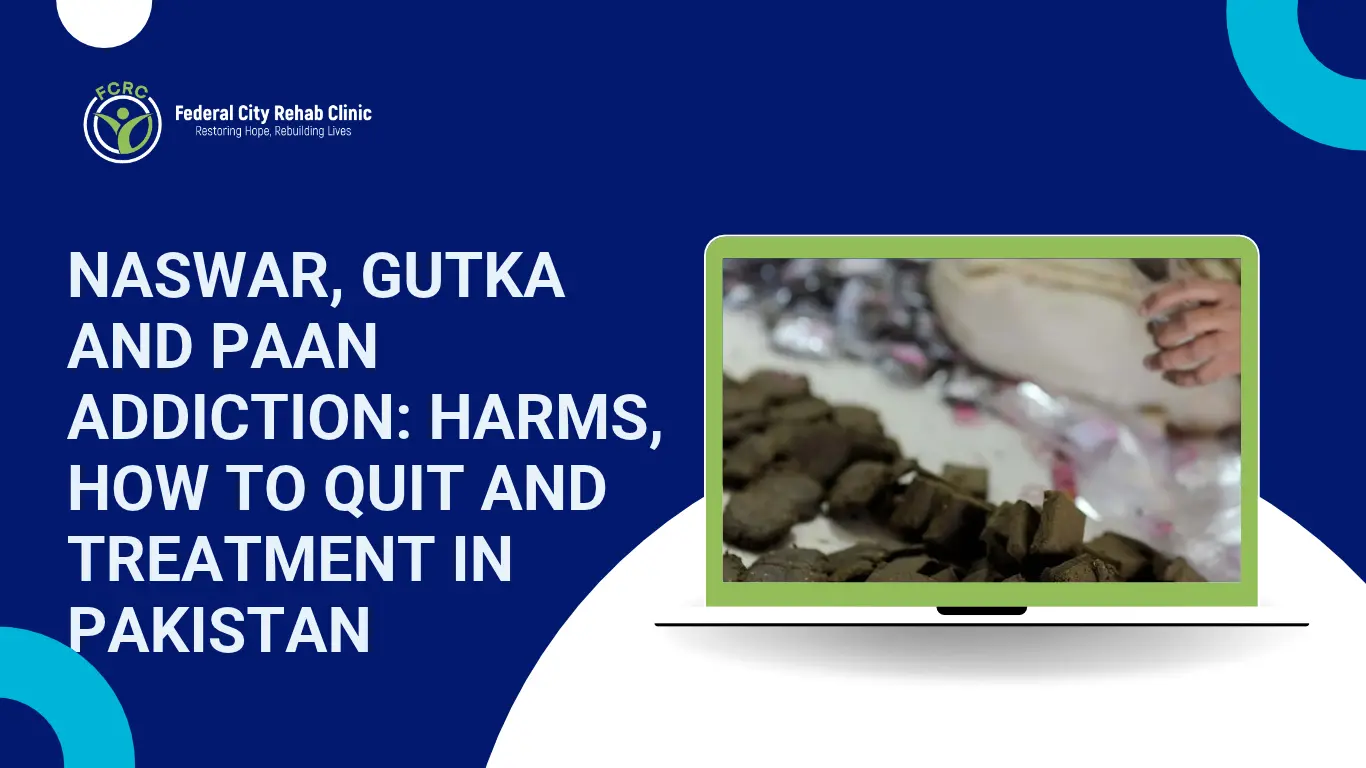
In many homes in Pakistan, naswar is as ordinary as tea. A pinch under the tongue after a meal, during a long drive, at the shop or at work. Gutka and paan with tobacco are just as common in other places. Because they are everywhere, people assume they are harmless. They are not. They are tobacco, they are highly addictive, and they are a leading cause of mouth cancer in this country.
This guide explains what naswar addiction and gutka addiction are, what tobacco paan is, why people cannot stop, what the evidence says about naswar side effects and gutka side effects, what withdrawal feels like and how to quit with the right support. If you want to talk to someone, Talk to our admissions team on WhatsApp. Your message is confidential.
اردو خلاصہ: نسوار، گٹکا اور تمباکو والا پان نشہ آور ہیں اور منہ کے کینسر کا بڑا سبب ہیں۔ نسوار چھوڑنے کا طریقہ یہ ہے کہ ڈاکٹر سے مشورہ کیا جائے، رویّے کی مدد اور ضرورت ہو تو دوا لی جائے، اور اچانک نہیں بلکہ منصوبے کے ساتھ چھوڑا جائے۔
What are naswar, gutka and paan with tobacco?
These are all forms of smokeless tobacco. Nothing is lit, and the tobacco is absorbed through the lining of the mouth.
- Naswar is made from dried tobacco leaves, ash, lime and flavoring, according to a study of naswar in Peshawar and Abbottabad. It is placed between the gum and the cheek. The same study notes that its manufacture and sale are unregulated in Pakistan, so what is in any one packet varies. It is used mainly in Pashtun communities in Pakistan and Afghanistan, and Khyber Pakhtunkhwa has the highest number of users in Pakistan.
- Gutka is a commercially made, often sweetened and flavored dry mixture, usually with tobacco and areca nut. The World Health Organization’s regional office notes it is increasingly popular among young people and women in some countries.
- Paan with tobacco is betel leaf with areca nut, lime and tobacco. WHO also lists chalia and supari among these products.
Names and mixes differ from place to place, but the harm comes from the same two things: tobacco and areca nut.
Why naswar addiction and gutka addiction are so hard to break
Tobacco contains nicotine, and nicotine creates dependence. WHO states that smokeless tobacco is highly addictive and that nicotine is absorbed more easily from smokeless tobacco than from cigarettes. People who use naswar or gutka often keep a pinch in the mouth for long periods, so the body gets a steady supply, and soon it expects it.
Habit and routine make it harder. Naswar is tied to meals, tea, waiting, driving, stress and boredom. Many users do not think of themselves as addicts, which is why they never ask for help.
Signs of dependence
You may be dependent if you:
- Use it every day, and feel uneasy when you cannot
- Reach for it soon after waking
- Use it more often or in larger amounts than before
- Have tried to cut down or stop, and could not
- Need it to feel calm, to concentrate or to get through stress
- Keep using even though your mouth, teeth or gums hurt, or a doctor has warned you
Several of these together is a good reason to speak to a professional.
Naswar side effects and the risk of mouth cancer
Smokeless tobacco contains many cancer causing toxins, according to WHO, and it raises the risk of cancers of the mouth, throat, head and neck, as well as dental disease. WHO adds that in Pakistan, where smokeless tobacco use is high, oral cancer rates are among the highest in the world.
The evidence on naswar in particular is strong:
- A study in Peshawar and Abbottabad compared 84 people with oral cancer and 174 matched people without it. Ever users of naswar had more than a 20 fold higher risk of oral cancer than never users, and the risk was higher in people who had used it for longer. The authors estimated that about 59 percent of oral cancers in Pakistan, and 75 percent in Khyber Pakhtunkhwa, could be attributed to naswar. This is one hospital based study, and the authors say the findings still need confirmation by independent research, but the direction of the result is consistent with other work.
- The International Agency for Research on Cancer (IARC) reported in October 2024, in The Lancet Oncology, that smokeless tobacco and areca nut caused about 31 percent of oral cancers worldwide in 2022. For Pakistan, it estimated that 8,900 oral cancer cases that year were attributable to these products. Naswar was responsible for 52 percent of oral cancer cases among men and 21 percent among women. Tobacco paan accounted for 12 percent of cases, and gutka for 9 percent among men. These are the IARC’s estimates, not exact counts.
Other effects of naswar and smokeless tobacco include:
- Gum disease, stained teeth, tooth loss and bad breath
- White or red patches inside the mouth, which can be an early warning sign
- Sores that do not heal
- Dependence on nicotine
Gutka side effects
Gutka carries the same risks as other smokeless tobacco, with one more: oral submucous fibrosis. WHO describes it as a serious and debilitating condition with no cure, strongly linked to gutka, and says it can appear even after a short period of use. The mouth becomes stiff and painful, and opening it becomes hard. Areca nut is a major cause.
Gutka also contains sweeteners and flavorings that make it attractive to young people, who may start without realizing what it is.
Is naswar safer than cigarettes?
No. WHO states plainly that smokeless tobacco is not a safe alternative to cigarettes. Switching from smoking to naswar or gutka does not remove the risk. It swaps lung risk for mouth, throat and gum risk, and it keeps the nicotine addiction.
Warning signs to get checked
See a doctor or dentist soon if you use naswar, gutka or tobacco paan and notice:
- A white or red patch inside the mouth that does not go away
- A sore or ulcer that does not heal
- A lump in the mouth, cheek or neck
- Pain or difficulty swallowing, or difficulty opening the mouth
- Loose teeth or bleeding gums without another cause
Do not wait. Early mouth cancer is far easier to treat than late. [Dr. Kifayat to confirm this list and whether to add a time limit for ulcers.]
What quitting naswar or gutka feels like
When you stop, the body reacts to the loss of nicotine. People commonly report:
- Strong cravings, especially in the first days
- Irritability, restlessness and a short temper
- Anxiety and low mood
- Trouble concentrating and trouble sleeping
- Increased appetite
These symptoms are uncomfortable but not dangerous in the way that alcohol or tablet withdrawal can be. They usually ease over days and weeks, and cravings can return later in situations tied to the habit. [Dr. Kifayat to confirm this section.]
How to quit naswar and gutka
The best evidence on quitting comes from tobacco generally. WHO published its first clinical guideline on tobacco cessation in adults in July 2024. It applies to adults trying to quit any tobacco product, including smokeless tobacco, and its main messages are:
- Behavioral support helps. Brief advice from a health worker should be offered routinely, and more intensive support, such as individual, group or phone counseling, should be available to those who want it.
- Medicines help. WHO recommends four treatments: varenicline, nicotine replacement, bupropion and cytisine. A doctor decides which one, if any, is right for you.
- Both together work better. Combining behavioral support with medicine substantially improves quit rates.
- Digital tools can support you, such as text messages and apps, alongside other help.
WHO’s summary does not give separate advice for smokeless tobacco users, so I have not claimed that any one medicine works best for naswar. Ask a doctor.
Practical steps that fit this evidence:
- Choose a quit day and tell your family or a friend who will support you.
- Remove it from sight. Throw out your supply and avoid buying “one last packet.”
- Know your triggers, such as after meals, with tea, at the shop, driving, during stress, with friends who use it, and plan what you will do instead.
- Give your mouth and hands something else, such as water, cardamom, fennel seeds, sugar free gum or a walk.
- Expect cravings, and remember that each one passes in minutes if you do not feed it.
- Ask a doctor about medicine rather than buying products on your own.
- Do not treat a slip as failure. Many people need several attempts. Learn from it and start again.
- Look after your dentist visits, and have your mouth checked.
When stress, anxiety or other substances are involved
Many people use naswar to cope with stress, anxiety, boredom or low mood. If you stop and the anxiety comes back, or you find yourself replacing it with something else, a doctor can help you deal with the cause. See our Anxiety Disorder Treatment page and our Psychiatrist in Islamabad page.
Some people also use charas, alcohol, tablets or other drugs. If that is you, treating all of it together gives better results. See our Cannabis Addiction Treatment, Drug Addiction Treatment and Dual Diagnosis Treatment pages.
How we can help at FCRC
If you want to quit but cannot manage alone, you can arrange a private assessment with our clinical team in Bani Gala, Islamabad. A doctor reviews your use, your health and your mood, talks through medicine options and plans support. Our psychologists offer Counseling and Therapy, including CBT, to help with cravings, triggers and stress. Our Family Support Program helps relatives support you without nagging, and Relapse Prevention planning helps you stay quit. You can also take our Free Mental Health Self Check, which uses the PHQ-9 and GAD-7 questionnaires for low mood and anxiety.
[Confirm with the clinical team that FCRC offers a quit tobacco assessment and therapy before publishing this section. Edit it to match what is offered.]
How families can help
- Do not nag, shame or hide the person’s supplies. It usually makes people use more.
- Praise every day without it.
- Do not buy it for them, even when they ask.
- Learn the warning signs of mouth cancer and encourage a check.
- Support them in seeing a doctor.
Frequently Asked Questions
What is naswar addiction, and is naswar addictive?
Naswar addiction is dependence on the nicotine in naswar. Yes, naswar is addictive. It contains tobacco, and nicotine from smokeless tobacco is absorbed easily through the mouth. Most regular users become dependent.
What are the side effects of naswar?
Naswar damages gums and teeth and can cause white patches and sores in the mouth. The strongest concern is oral cancer. A study in Peshawar and Abbottabad found more than a 20 fold higher risk in ever users.
Does naswar cause mouth cancer?
It is strongly linked to it. IARC estimated that naswar caused 52 percent of oral cancers in men and 21 percent in women in Pakistan in 2022.
What are the side effects of gutka?
Gutka causes gum disease, tooth damage and oral cancer, and is strongly linked to oral submucous fibrosis, a painful and incurable stiffening of the mouth.
Is naswar safer than cigarettes?
No. WHO states that smokeless tobacco is not a safe alternative to cigarettes.
How do I quit naswar?
Set a quit day, remove your supply, plan for triggers, and get behavioral support and, if a doctor advises, medicine. Combining support with medicine improves quit rates.
How long does naswar withdrawal last?
Cravings and irritability are usually strongest in the first days and ease over weeks, though cravings can return in familiar situations. Ask a doctor about your own case.
Can I quit naswar suddenly?
Yes, many people do. Unlike alcohol or tablets, it is not dangerous to stop suddenly, but support and a plan make it more likely to last.
Are there medicines to help quit smokeless tobacco?
WHO recommends varenicline, nicotine replacement, bupropion and cytisine for adults who want to quit tobacco. A doctor decides what is suitable and whether any of these fit smokeless tobacco.
Is paan with tobacco as harmful as naswar?
Both are harmful. IARC attributed 12 percent of oral cancer cases in Pakistan to tobacco paan and 9 percent in men to gutka.
When should I see a doctor?
If you have a patch, a sore or a lump in your mouth that does not go away, trouble swallowing or opening your mouth, or you cannot quit on your own.